 11
 1
 2
 3

Former FTX chief operating officer Constance Waing has strongly criticized Netflix’s portrayal of Binance founder Changpeng Zhao in its docuseries The Altruists, labeling it "very racist" and alleging it relies on harmful Asian mafia stereotypes. The series, which dramatizes the rise and fall of Sam Bankman-Fried’s FTX crypto empire and his subsequent fraud conviction, has drawn fire from Waing for specific scenes that she believes perpetuate negative stereotypes.
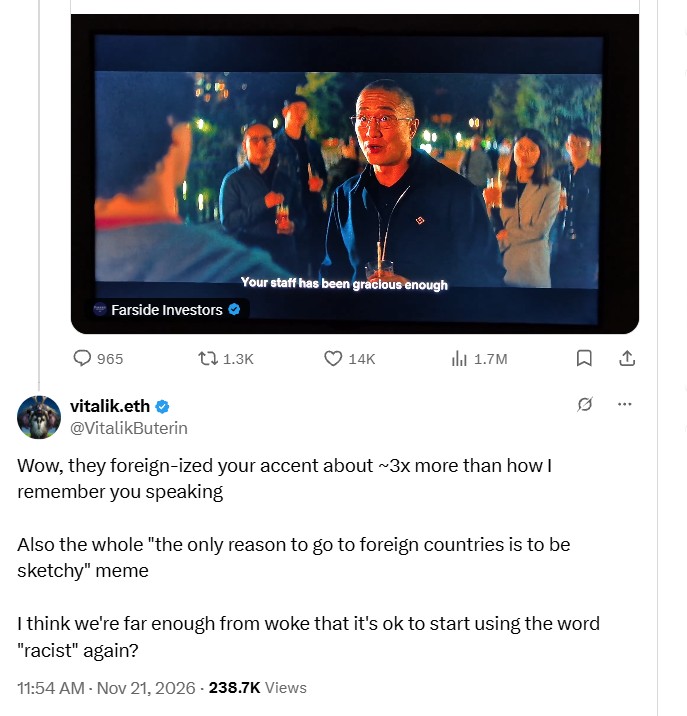
Waing pointed to a scene where FTX founder Sam Bankman-Fried (SBF) and Alameda CEO Caroline Ellison enter through a back door to meet CZ. Waing interprets this depiction as suggesting CZ was luring "innocent people into something bad." Further adding to the controversy, another episode features a fictionalized CZ urging SBF to grant Alameda Research advance access to FTX customer orders for proprietary trading. The real Changpeng Zhao has publicly denounced this suggestion as "insane." The portrayal has also attracted scrutiny from Ethereum creator Vitalik Buterin, who questioned the alleged exaggeration of Zhao’s accent and raised concerns about potential racism, stating, "Woke 1 may have been crazy, but racist is still racist."
South Korea: Exchanges Halt CYBER Transfers Amid Suspected Bridge Exploit; Proposes Bank-Led Stablecoins and Exchange Stake Caps
South Korean cryptocurrency exchanges Upbit and Bithumb have suspended all deposits and withdrawals of the CYBER token following reports of suspicious activity on its cross-chain bridge. The Cyber project, formerly known as CyberConnect, announced on Saturday that it detected an unauthorized minting of CYBER tokens on the Solana blockchain, followed by a transfer of these tokens from its bridge’s Ethereum lockbox. CyberConnect operates an Ethereum layer-2 network designed for social applications. The project is currently investigating the incident and has advised users to refrain from using the bridge or depositing CYBER to exchanges until the investigation is concluded.
In a separate development, South Korea’s Financial Services Commission (FSC) has unveiled a draft bill proposing significant changes to the country’s digital asset regulations. The proposed legislation would initially restrict the issuance of won-denominated stablecoins to entities majority-owned by banks. Furthermore, it aims to impose a general cap of 20% on shareholder stakes in cryptocurrency exchanges. The draft bill also seeks to lift South Korea’s 2017 ban on domestic initial coin offerings (ICOs). The 20% ownership rule is particularly noteworthy as it could impact a prior agreement where Naver gained full control of Upbit owner Dunamu. Under the new regulations, shares exceeding the 20% cap would lose their voting rights.
Industry analysts suggest that South Korea’s proposed crypto bill could reshape the stablecoin landscape beyond mere token issuance. According to a report by Tiger Research, South Korean fintech companies might gain influence within bank-led stablecoin groups by forging partnerships that facilitate the spending of won-denominated tokens. The report emphasizes that "those relationships are likely to matter more to the business than the volume of stablecoins issued."

North Korea: US Seeks Recovery of $1.1 Billion in Crypto Stolen in Binance Hack
The United States Department of Justice is actively pursuing the recovery of over $1.1 billion in cryptocurrency that was stolen from the Binance exchange in October by hackers linked to North Korea. In a court filing submitted on Monday, federal prosecutors requested a Washington D.C. court to permanently forfeit these funds, which are currently held in the USDC stablecoin. Authorities in the U.S. have stated that since the attack, they have been instrumental in freezing, seizing, or returning nearly $3 billion of the more than $6 billion that was taken from Binance.
Japan: SBI, SMFG Launch Solana Venture for Stablecoins and Tokenization; FSA Considers DeFi Regulations
Japanese financial giants SBI Holdings and Sumitomo Mitsui Financial Group (SMFG) have joined forces with the Solana Foundation to establish a joint venture focused on tokenizing assets, developing stablecoin payment infrastructure, and expanding on-chain financial services across Asia. This strategic alliance signals a significant push by traditional financial institutions in Japan to engage with blockchain technology and decentralized finance.
In related news, Japan’s Financial Services Agency (FSA) has published briefing materials outlining proposals for regulating applications and websites that connect to decentralized finance (DeFi) protocols. The agency is also considering whether to discourage access to protocols that lack robust anti-money laundering (AML) controls. Meanwhile, Daiwa has successfully completed a technical verification process where artificial intelligence (AI) agents processed natural language instructions to screen various decentralized exchange (DEX) options and to execute stablecoin and security token swaps, demonstrating the growing role of AI in financial technology.
Hong Kong: Launches Tokenized Debt Platform with 24-Hour Settlement; Pushes for Crypto Custodian and Advisor Licensing
The Hong Kong Monetary Authority (HKMA) has launched a new platform designed to facilitate round-the-clock settlement of tokenized debt securities in multiple currencies. The CMU Digital Asset Platform, developed and operated by CMU OmniClear Limited on behalf of the HKMA, utilizes cash tokens for payment and integrates with conventional payment systems and central bank digital currencies. This initiative marks a significant step forward in Hong Kong’s efforts to embrace digital assets within its financial infrastructure.
Furthermore, Hong Kong is moving to bring crypto custodians, advisers, and other virtual asset service providers under mandatory licensing and registration rules. The government officially published the Virtual Asset Services Legislation (Amendment) Bill 2026, which proposes that firms engaging in these activities must obtain a license from, or register with, the Securities and Futures Commission (SFC). The bill is scheduled for its first reading in the Legislative Council on December 2nd. In another development, BlackRock has launched its first tokenized money market fund in Hong Kong and the broader Asia-Pacific region. This fund allows investors to utilize the new HK stablecoin, HKDAP, for subscriptions and redemptions, offering a stable net asset value.
Singapore: Clarifies Tokenized Deposits; Asset Recovery in Money Laundering Case
The Monetary Authority of Singapore (MAS) has issued clarifications regarding the nature of on-chain tokens, emphasizing that an on-chain token is not automatically considered a bank deposit. The MAS is drawing a distinction between genuine tokenized deposits and instruments that function more like crypto-based bearer instruments. In a separate legal matter, a UK court has approved an asset recovery settlement totaling 55 million pounds. This settlement is part of Singapore’s largest money-laundering case, involving defendants Su Haijin and Xu Haika. Haika is reportedly being compelled to sell 16 London apartments held through affiliated companies to repay the funds. The August 2023 police operation that uncovered this case resulted in the seizure of crypto assets valued at over S$38 million.
China: Bitmart Faces Significant Shortfall Amid High-Yield Product Collapse
According to a report by Nikkei Asia, the cryptocurrency exchange Bitmart is facing a substantial shortfall of $319.5 million, with only $1.9 million in liquid assets available for customer repayments. Numerous users have reported an inability to access their accounts on the platform. Bitmart disclosed these figures to Alvarez & Marsal, the firm overseeing its restructuring process. The exchange’s collapse underscores the inherent risks associated with high-yield crypto products. Chinese investors were reportedly attracted to Bitmart by short-term savings products offering annualized yields of 18.8% for 14-day deposits, highlighting the allure of potentially high returns in the crypto market.