 11

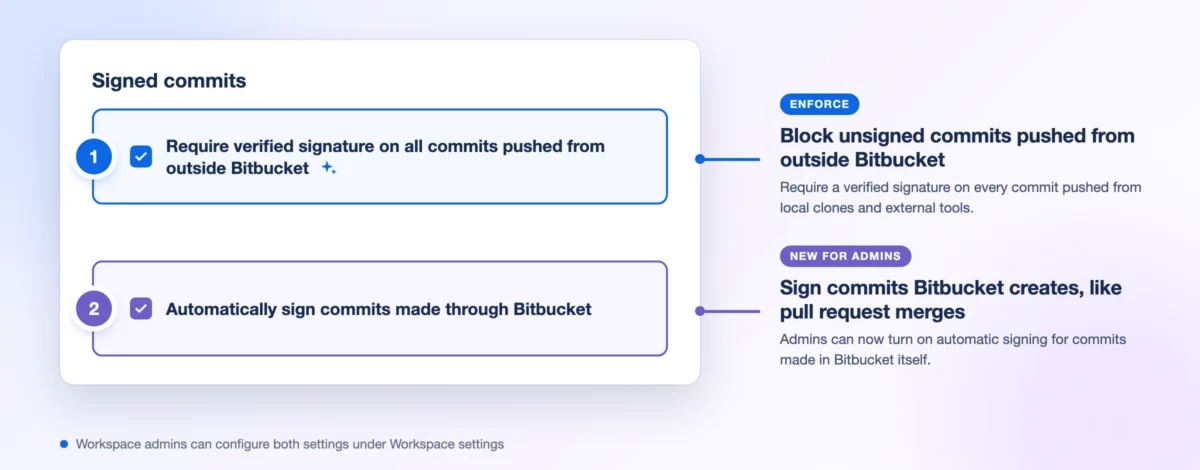
Atlassian has announced a significant expansion of its security suite for Bitbucket Cloud, introducing workspace- and project-level signed commit enforcement. This new capability is designed to provide administrators with centralized control over code integrity, allowing them to mandate valid and verifiable digital signatures for all code contributions across their entire organizational scope. By enabling this feature, Bitbucket will systematically reject any commits that are unsigned or those with signatures that cannot be successfully validated against registered keys. This advancement is positioned as a critical tool for development teams seeking to apply consistent security policies at scale, ensuring that every line of code entering a repository can be traced back to a verified identity. This enhancement is categorized as a Premium feature, specifically available to organizations subscribed to Bitbucket’s Premium monthly and annual plans.
The rollout represents a strategic evolution of Bitbucket’s security roadmap, building upon the platform’s existing support for GPG (GNU Privacy Guard) and SSH (Secure Shell) signatures. While individual repository-level signing has been available previously, the transition to workspace- and project-level enforcement addresses a major pain point for large-scale enterprises: the difficulty of maintaining uniform security standards across hundreds or thousands of disparate repositories. By moving enforcement to a higher hierarchical level, Atlassian is empowering workspace administrators to eliminate "shadow" configurations where individual repository settings might otherwise bypass corporate security mandates.

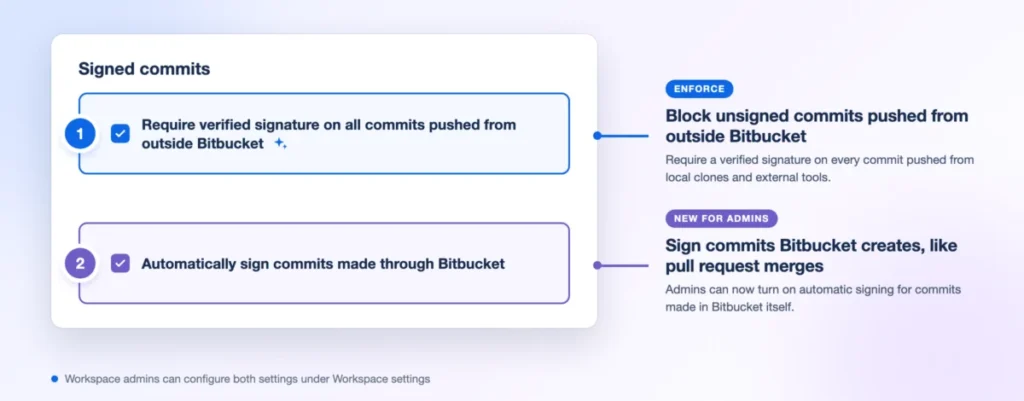
The technical architecture of this update introduces two distinct but complementary settings: system-signed commits and the enforcement of signed commits. This separation of concerns grants administrators granular control over the various ways code is introduced into their environment. While enforcement focuses on code pushed by individual contributors from their local machines, the system-signed commit feature addresses actions taken directly within the Bitbucket web interface. To ensure a closed-loop security environment, Bitbucket now has the capability to automatically sign commits created within the Bitbucket app itself—such as those generated through the web-based file editor or via merge operations. This ensures that even when a developer is not using a local Git client, the resulting changes remain compliant with the organization’s signature requirements.
The mechanism of enforcement is built on a strict inheritance model. When an administrator enables signed commit enforcement at the workspace level, that policy is automatically inherited by every project and repository contained within that workspace. Similarly, if the policy is enacted at the project level, it flows down to all constituent repositories. A key feature of this hierarchy is its "lock-down" capability: if enforcement is enabled at a higher level, the setting cannot be disabled or overridden at a lower level. For instance, a repository lead cannot opt-out of signature requirements if the workspace administrator has mandated them. However, the system is designed with flexibility for policy shifts; should enforcement be disabled at the higher level at a later date, the lower-level settings are restored to their previous configurations, allowing teams to resume localized management if desired.
To facilitate these changes, Atlassian has updated the Workspace Settings and Project Settings interfaces. Administrators can now navigate to these centralized dashboards to toggle enforcement on or off. Once the "Require signed commits" toggle is activated, Bitbucket begins the process of validating the cryptographic signatures of every push. If a contributor attempts to push a commit that lacks a signature, or if the signature does not match the public keys associated with the user’s account, the push is rejected with a clear error message. This immediate feedback loop ensures that developers are aware of the security requirements and can rectify their local Git configurations to include GPG or SSH signing.

The importance of this feature cannot be overstated in the context of modern cybersecurity threats, particularly those targeting the software supply chain. In recent years, high-profile attacks have demonstrated that compromising a developer’s credentials or impersonating a trusted contributor can lead to the injection of malicious code into a codebase. Signed commits serve as a powerful defense against such impersonation. By requiring a private key—which remains on the developer’s hardware or in a secure vault—to "sign" each change, the organization can be certain that the person who authored the code is indeed who they claim to be. This establishes a verifiable "chain of custody" for every modification, providing a high degree of confidence in the provenance of the source code.
Furthermore, the enforcement of signed commits is a significant boon for organizations subject to rigorous regulatory audits and compliance frameworks. Standards such as SOC2, HIPAA, and various ISO certifications often require organizations to demonstrate robust controls over who can change production code and how those changes are verified. With workspace-level enforcement, administrators can generate audit trails and reports that prove a consistent security policy was in effect across the entire development lifecycle. Instead of auditing repositories individually, auditors can verify the global setting, significantly streamlining the compliance process.
The integration of SSH signatures alongside GPG signatures is another detail that enhances the usability of this feature. While GPG has long been the standard for Git signing, it is often viewed by developers as cumbersome to set up and manage. SSH signing, a more recent addition to the Git ecosystem, allows developers to use the same SSH keys they already use for authentication to sign their commits. By supporting both, Bitbucket ensures that teams can choose the cryptographic method that best fits their existing workflows without sacrificing security.

For developers, the transition to a signed-commit environment requires a one-time setup of their local Git environment. This involves generating a key pair, adding the public key to their Bitbucket profile, and configuring Git to automatically sign every commit. While this adds a small layer of initial configuration, the long-term benefit is a significantly hardened development environment. When combined with Bitbucket’s automatic system signing, the friction of maintaining a signed codebase is minimized. When a merge occurs or a pull request is completed through the Bitbucket UI, the platform uses its own internal keys to sign the resulting merge commit, ensuring the continuity of the verified history.
Atlassian’s decision to gate this feature behind the Premium plan reflects its focus on serving enterprise-grade customers who operate in high-stakes environments. These organizations typically manage complex project portfolios and require the centralized governance that workspace-level settings provide. By providing these tools, Bitbucket Cloud is positioning itself as a leader in secure DevOps, moving beyond simple version control to become a comprehensive platform for secure software delivery.
As organizations continue to face an evolving landscape of digital threats, the ability to enforce security policies at scale becomes a competitive necessity. The introduction of workspace- and project-level signed commit enforcement in Bitbucket Cloud provides the transparency, accountability, and protection required by modern engineering teams. It bridges the gap between individual developer responsibility and corporate security mandates, ensuring that the integrity of the source code is never compromised. Through this rollout, Bitbucket reinforces its commitment to helping teams build not just faster, but more securely, by providing the dependable controls necessary to safeguard the world’s most sensitive intellectual property. Organizations interested in implementing these controls are encouraged to review the updated help documentation provided by Atlassian to begin configuring their workspace and project settings for maximum security.