 11
 1
 2
 3

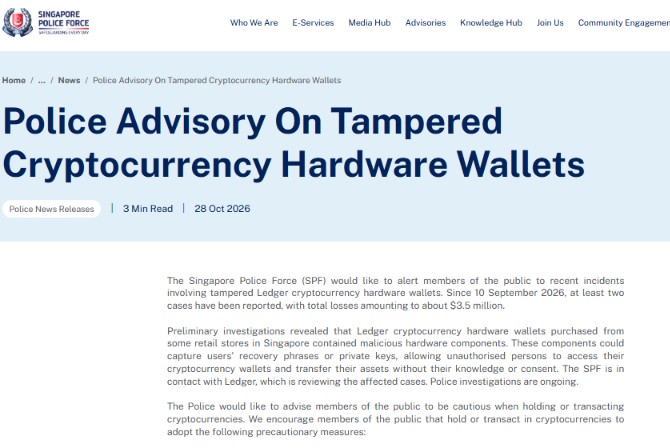
Singaporean authorities have reported a concerning trend involving tampered Ledger hardware wallets, with at least two cases coming to light since September 10th. These incidents have resulted in substantial financial losses for local users, amounting to approximately 3.5 million Singapore dollars (equivalent to $2.7 million USD). Notably, the first local report of such a tampered device surfaced nearly a month before the broader issue became publicly known. The exact timeline of the initial September 10th report remains unclear from an October 28th consumer alert issued by the police. It is uncertain whether this case was reported to the police at the time of discovery or retrospectively. If the report was made promptly, it raises pertinent questions about whether Ledger, the manufacturer, was duly informed, and if the Singapore Police Force was in a position to issue an earlier public warning. However, the October 28th advisory indicated that the police investigation was still in its preliminary stages.
Ledger itself issued a public alert on October 9th concerning tampered Ledger devices found within the CryptoBilis supply chain. This alert followed the discovery of hardware wallets containing spyware components, which led to the draining of nearly $100 million from affected user accounts. In response to these ongoing investigations, Ledger announced on October 13th that it had requested retailers across several Southeast Asian countries and Hong Kong to suspend sales of its devices. These countries include Indonesia, Singapore, Thailand, the Philippines, Vietnam, Malaysia, and Hong Kong. The Singapore Police’s warning, issued three weeks after Ledger’s global story broke, underscores the gravity of the situation and the potential for widespread impact.
Malaysia and Thailand Join Singapore’s Initiative for Cross-Border Stablecoin Payments
In parallel developments within the region’s financial landscape, Bank Negara Malaysia and the Bank of Thailand have joined Singapore’s BLOOM initiative as policymaker members. BLOOM, an acronym for Borderless, Liquid, Open, Online, Multi-currency, is a collaborative public-private endeavor designed to facilitate the use of stablecoins and tokenized deposits for cross-border payments. Launched by the Monetary Authority of Singapore in October of the previous year, BLOOM boasts an impressive roster of members, including major financial institutions and technology companies such as Airwallex, Mastercard, Ripple, Visa, and the World Bank Group.
Further supporting the growing interest in digital assets for financial transactions, a recent survey conducted by Singaporean bank DBS revealed significant corporate enthusiasm for tokenized money. The survey, which polled 422 global businesses, found that nearly 90% of respondents are either actively adopting or are keenly interested in adopting tokenized cash solutions to expedite payment processes. This indicates a strong market pull for innovative and efficient payment mechanisms facilitated by blockchain technology.
South Korea Grapples with Potential Fourth Delay of Cryptocurrency Tax Implementation

South Korean government officials are reportedly considering yet another postponement of the country’s cryptocurrency tax policy, which is currently slated for implementation in January 2027. This potential delay marks the fourth consideration of such a postponement, highlighting the ongoing complexities and debates surrounding the taxation of digital assets. According to a report from South Korean news outlet Newsis on Monday, the crypto income tax could be pushed back to 2029. A significant factor influencing this decision is the anticipated timeline for the exchange of tax-related information on digital assets with the United States, with officials indicating that such data sharing would only become feasible by 2029. The proposed policy aims to impose a 22% tax on crypto gains for investors earning more than 2.5 million Korean won (approximately $1,883 USD) annually.
Compounding the regulatory landscape, South Korea has also experienced a spate of data breaches affecting major financial firms. Bithumb, a prominent cryptocurrency exchange, reported that its in-house mobile system was compromised, leading to the leakage of personal information. Additionally, brokerage firm Daishin Securities confirmed the exposure of approximately 38,000 customer records, and asset manager Mirae Asset Global Investments acknowledged a hacking incident.
In a move towards greater oversight of digital assets, the South Korean government and the Bank of Korea intend to draft amendments to the Foreign Exchange Transactions Act within the current year. These amendments will focus on regulating stablecoins when used as payment instruments. Furthermore, the central bank will mandate that crypto transfer service providers submit monthly reports detailing cross-border transfers. These reporting requirements, effective from December 2nd, will necessitate a look-back period extending to mid-2024, aiming to enhance transparency and track capital outflows.
Chainalysis Uncovers North Korean Crypto Cash-Out Network Facilitated by Russian Intermediaries
Blockchain analytics firm Chainalysis has successfully mapped a long-standing network of Russian intermediaries that have been instrumental in facilitating the cashing out of millions of dollars in cryptocurrency by North Korean IT workers. This discovery sheds light on the sophisticated methods employed by North Korea to circumvent international sanctions and fund its illicit activities. In response to these findings, the U.S. Department of the Treasury’s Office of Foreign Assets Control (OFAC) sanctioned 10 individuals and one entity on Wednesday. These sanctions were imposed for their alleged support of North Korean government-run IT worker schemes, which OFAC stated were used to finance the country’s weapons programs. Among those sanctioned are Russian nationals Ilya Aleksandrovich Boykov and Vitold Viktorovich Obertas.
Hong Kong Designates Nasdaq-Listed Solana Company as a Strategic Enterprise, Bolstering its Economic Development Ambitions
Hong Kong has officially designated Solana Company (HSDT), a Nasdaq-listed entity, as a strategic enterprise under a government program aimed at attracting businesses that contribute to the city’s economic growth. Solana Company announced on Thursday that it was selected as part of the seventh batch of businesses chosen by Hong Kong’s Office for Attracting Strategic Enterprises (OASES). Significantly, it is the only blockchain infrastructure company onboarded by OASES in 2026, underscoring Hong Kong’s commitment to fostering innovation in this sector. The Hong Kong government confirmed the addition of 18 enterprises to the program last week, bringing the total number of strategic enterprises to 142.
In a related development, China is reportedly looking to leverage Hong Kong as a crucial launchpad for the international adoption of its digital yuan. The South China Morning Post reported that Beijing intends for Hong Kong to play a pivotal role in seeding the global use of the digital yuan, exploring its potential to expand beyond domestic applications. Furthermore, Hong Kong-based crypto payments firm RedotPay is reportedly planning to launch an Initial Public Offering (IPO) in the United States before the end of the year. The company has initiated a pre-IPO funding round, valuing the firm at an impressive $4 billion.
China Sets 2030 Target for National Blockchain Network Completion, Prioritizing Technological Advancement
China has established a clear target of largely completing its national blockchain network by 2030, as outlined in a five-year digital development plan released on Friday. This ambitious plan also emphasizes the importance of strengthening blockchain technical standards and increasing the utilization of this technology in data circulation and trading. While mainland China maintains a ban on cryptocurrency-related business activities, it actively promotes blockchain technology as a national priority. However, critics of this approach argue that the concept of "blockchain-not-crypto" has yet to demonstrate widespread practical success.
Thailand’s Supreme Court Recognizes Bitcoin as Legal Property, Paving the Way for Future Legal Precedents
In a significant legal development, Thailand’s Supreme Court has ruled that Bitcoin qualifies as property under criminal law. This landmark decision establishes a precedent that is expected to influence how Thai courts handle other cryptocurrencies in future cases. The ruling was made in connection with a robbery case involving approximately $50,000 worth of Bitcoin, where the court upheld a 10-year prison sentence.
In an effort to cater to the needs of international visitors, Thailand has launched a digital wallet named WORPT. This initiative, part of the Tourist DigiPay sandbox, allows tourists to convert stablecoins such as USDT or USDC into Thai baht, enabling them to make payments via PromptPay QR codes. This move aims to simplify transactions for tourists and promote the use of digital payment methods within the country.