 11
11
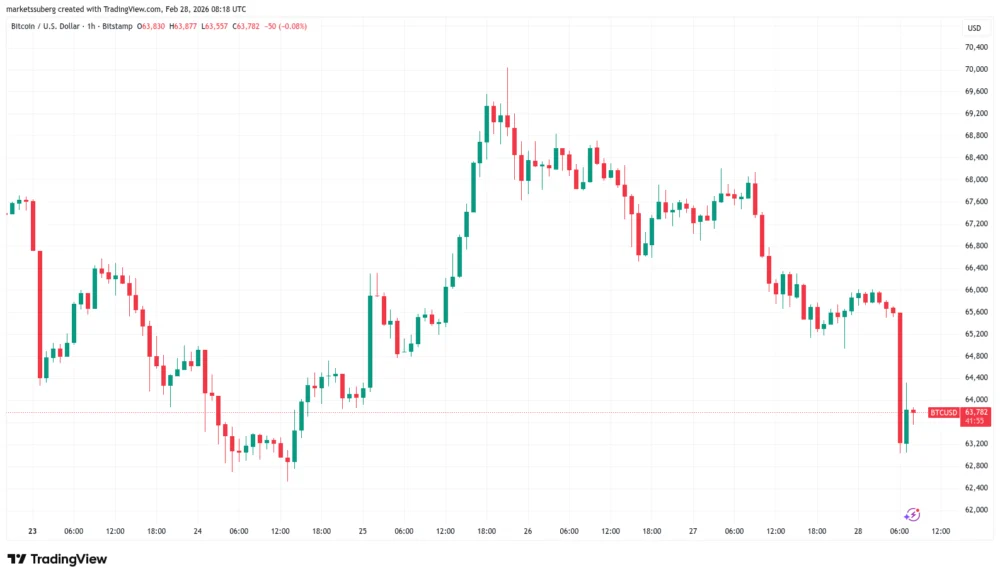
Bitcoin (BTC) experienced significant daily losses, nearing 4% on Saturday, as the United States and Israel announced a joint military operation in Iran. This development unfolded over a weekend, a period when traditional financial markets were closed, leaving cryptocurrencies to independently process and react to the escalating geopolitical tensions. Despite the downward price action, key support levels for Bitcoin have so far remained intact.
Data from TradingView indicated that the price of BTC was testing the $63,000 mark as the crypto market grappled with the implications of the weekend’s events. The situation was further amplified by a video address from former US President Donald Trump, who, in a statement released on Truth Social, urged Iranians to "take over your government." Trump framed the military operation as a targeted effort against Iran’s nuclear infrastructure but concluded his remarks with a direct call to action for the Iranian populace.
"When we are finished, take over your government; it will be yours to take," Trump stated, adding, "This will be, probably, your only chance for generations. For many years, you have asked for America’s help, but you never got it."
With the US stock market futures yet to open, Bitcoin and the broader cryptocurrency market were the sole financial instruments to immediately respond to the fresh wave of geopolitical instability. Data from CoinGlass revealed that liquidations in the cryptocurrency market surpassed $250 million within the four hours leading up to the report. This indicates a significant amount of leveraged positions being forcibly closed as traders reacted to the uncertainty.
The trading resource The Kobeissi Letter, in a response shared on X, highlighted the renewed conflict, noting, "The US and Israel now appear to be at war with Iran for the second time in 8 months." This reference points to a previous offensive by Iran in 2025, an event that had previously triggered an immediate and volatile reaction across both cryptocurrency and traditional risk assets. The historical precedent suggests that such geopolitical flare-ups have a pronounced impact on market sentiment and asset prices.
Bitcoin’s reaction on this occasion, while significant, occurred against a backdrop of familiar cues. The cryptocurrency’s ability to hold core support levels for BTC/USD is particularly noteworthy as the market approaches the final hours of the February monthly close. This escalation in geopolitical tensions arrives at a critical juncture for traders, who are closely watching the monthly candle close for indications of future price direction.
As previously reported, Bitcoin has seen its price decline significantly in February, mirroring losses experienced in February 2025. The cryptocurrency is on track to seal its fifth consecutive month of losses, a streak not observed in seven years. This extended period of negative monthly closes underscores the challenging market conditions that Bitcoin has been facing.
Adding to the headwinds for Bitcoin bulls, hot US inflation data was released on Friday. This economic indicator further pressured the price, coming after failed attempts by bulls to reclaim key support levels closer to the $70,000 mark. The combination of persistent inflation concerns and escalating geopolitical risks creates a complex environment for Bitcoin and other risk assets.
The current situation emphasizes Bitcoin’s unique position in the global financial landscape. As a digital asset that operates 24/7, it is often the first to react to major global events, especially when traditional markets are dormant. This weekend’s events in Iran and the subsequent market reaction highlight Bitcoin’s sensitivity to geopolitical news and its role as a potential barometer of global uncertainty.
The military operation in Iran, coupled with former President Trump’s provocative statements, introduces a significant layer of risk into the global economic outlook. Investors and traders are closely monitoring the developments, seeking to understand the potential duration and scope of the conflict, as well as its broader implications for international relations and global trade.
The fact that Bitcoin’s support levels are holding, despite the substantial daily losses and the broader context of geopolitical instability, could be interpreted in several ways. Some analysts may view it as a sign of underlying strength in Bitcoin, suggesting that demand remains robust even amidst external pressures. Others might see it as a temporary pause before further price discovery, dependent on how the geopolitical situation evolves.

The upcoming monthly close for Bitcoin will be a crucial determinant of sentiment for the near future. A sustained inability to break through key resistance levels, or a decisive break below current support, could signal a continuation of the bearish trend. Conversely, a rebound and subsequent upward momentum could indicate resilience and a potential shift in market sentiment.
The interplay between geopolitical events, macroeconomic data, and the technical landscape of Bitcoin continues to be a dominant narrative in the cryptocurrency market. As the situation in Iran unfolds, and as traditional markets prepare to open and react, the performance of Bitcoin will be closely scrutinized for further insights into its ability to navigate an increasingly complex and volatile global environment. The market’s reaction to this latest geopolitical development serves as a stark reminder of the interconnectedness of global events and their impact on digital assets.
The significant liquidation volumes observed also point to the heightened volatility and risk appetite in the market. Traders are actively adjusting their positions in response to the rapidly changing geopolitical landscape, leading to forced selling and price swings. This level of activity underscores the speculative nature of some trading strategies and the potential for substantial losses when market conditions shift abruptly.
The historical context provided by The Kobeissi Letter, referencing the 2025 Iran offensive, is crucial for understanding the market’s current reaction. Past events have demonstrated that conflicts involving Iran can have a ripple effect across global markets, impacting everything from oil prices to currency valuations. Bitcoin, as a relatively nascent asset class, is still establishing its long-term correlations with these traditional economic indicators and geopolitical events.
In conclusion, Bitcoin is currently navigating a period of significant geopolitical instability, a challenge amplified by the closure of traditional financial markets. While the cryptocurrency has experienced notable daily losses and substantial liquidations, key support levels have so far held. The market’s reaction is being influenced by escalating tensions in Iran and the ongoing dialogue from prominent political figures. The upcoming monthly close for Bitcoin, coupled with further developments in the geopolitical arena and the release of economic data, will be critical in determining the asset’s trajectory in the coming weeks. The resilience of Bitcoin’s support levels amidst these pressures will be a key indicator of its ability to withstand and potentially recover from such global shocks.