 11
11
Imagine attempting to truly empty a box. You meticulously remove every visible item, pump out all gases, and, with the aid of hypothetical advanced technology, even evacuate unseeable substances like dark matter. What, according to the principles of quantum mechanics, remains within? This seemingly straightforward question leads to a profoundly counterintuitive answer: the box, despite all efforts, is not empty. It remains filled with energy, and astonishingly, your rigorous attempts to clear it have barely diminished this intrinsic energetic content.
This pervasive, unavoidable energy residue is known as ground-state energy or, more commonly, zero-point energy (ZPE). It manifests in two primary forms. One is associated with fundamental fields, such as the electromagnetic field, which permeates all space. The other form is linked to discrete objects, like atoms and molecules. While it’s possible to dampen a field’s vibrations, eradicating every trace of its presence is impossible. Similarly, atoms and molecules retain a fundamental amount of energy even when cooled to temperatures arbitrarily close to absolute zero, a state where classical physics would predict all motion to cease. In both scenarios, the underlying quantum physics dictates this persistent energy.
Zero-point energy is an inherent characteristic of any material structure or object that is at least partially confined. This includes, for instance, an atom held within the electric fields of a molecule, or even individual particles within the vastness of the vacuum. The situation can be likened to a ball resting at the very bottom of a valley. The total energy of this ball comprises its potential energy (determined by its position) and its kinetic energy (related to its motion). To completely eliminate both components—to truly "zero out" its energy—you would need to precisely define both the ball’s exact position and its exact velocity simultaneously. However, this is precisely what the Heisenberg uncertainty principle, a cornerstone of quantum mechanics, forbids. The principle states that certain pairs of physical properties, such as position and momentum (which is related to velocity), cannot both be known with perfect precision. If you try to precisely measure one, the other becomes inherently uncertain. This fundamental quantum fuzziness prevents any system from ever being perfectly still or completely devoid of energy.
The deeper implications of zero-point energy ultimately hinge on the specific interpretation of quantum mechanics one adopts, a field rich with ongoing debate. However, one non-contentious observation holds true: if a collection of particles is situated in its absolute lowest energy state and their positions or velocities are subsequently measured, a spread of values will inevitably be observed. This means that despite being stripped of all classical energy, the particles will appear to be "jiggling" or exhibiting some form of residual motion. In some interpretations of quantum mechanics, this apparent motion is taken literally—the particles genuinely are in a state of constant, irreducible vibration. In other interpretations, however, this appearance of motion is considered a misleading carryover from classical physics, and there is no intuitive, classical way to fully picture or explain the true nature of what is happening at this fundamental quantum level.
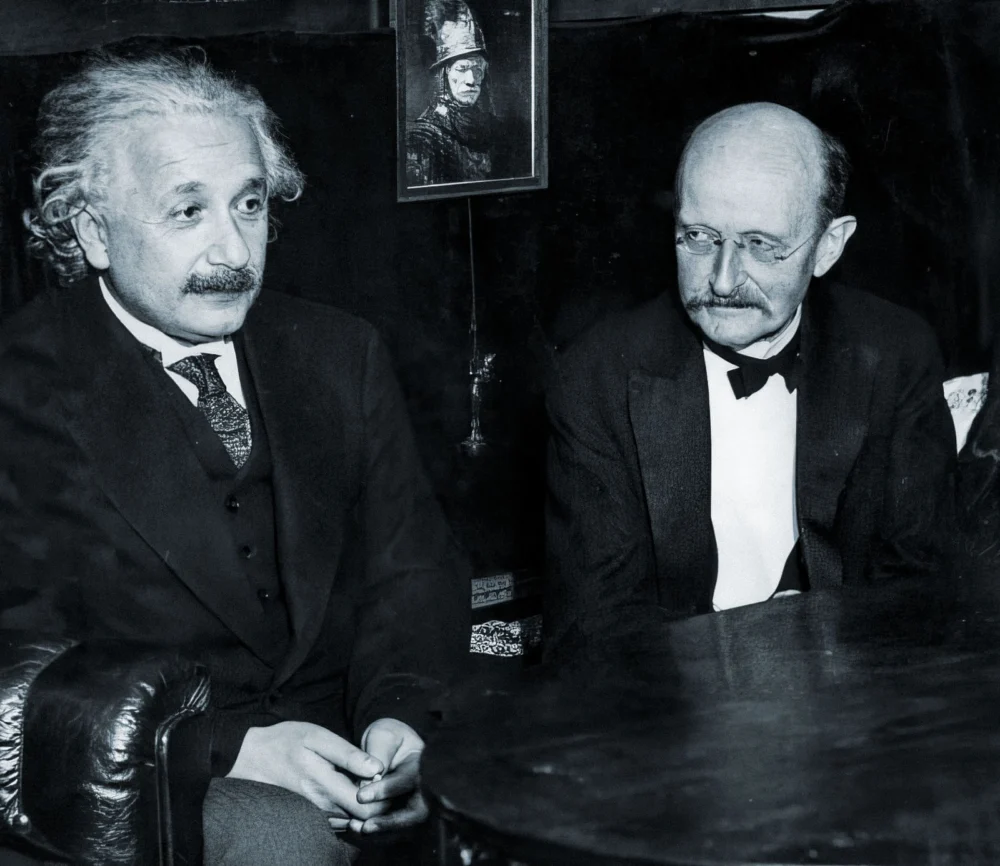
The concept of zero-point energy was first introduced by the pioneering physicist Max Planck in 1911, as he developed the nascent theories of quantum mechanics. It was, according to Peter Milonni, a theorist at the University of Rochester who specializes in the quantum vacuum, Albert Einstein who first truly recognized its profound significance. Einstein and other early quantum theorists soon invoked zero-point energy to explain a variety of perplexing phenomena that classical physics could not account for. These included the subtle, persistent vibrations observed in molecules and crystal lattices, even when they were in their theoretically lowest energy states. ZPE also provided an explanation for the peculiar behavior of liquid helium, which famously fails to condense into a solid under ordinary atmospheric pressure, even when cooled to temperatures so extraordinarily low that one would classically expect its atoms to lock rigidly into place. The inherent zero-point energy of helium atoms prevents them from settling completely, maintaining a fluid state.

Modern experiments continue to provide compelling evidence for the existence and effects of zero-point energy. A striking example was a study published in 2025 by researchers at the European X-Ray Free-Electron Laser Facility near Hamburg, among other institutions. The team undertook an experiment involving iodopyridine, an organic molecule composed of 11 atoms. They cooled this molecule almost to absolute zero, then subjected it to an intense laser pulse designed to break its atomic bonds. What the researchers discovered was remarkable: the motions of the freed atoms were found to be correlated, a clear indication that the iodopyridine molecule had been vibrating even in its extreme chilled state, defying classical expectations of stillness. Rebecca Boll, an experimental physicist at the facility, commented on the unexpected nature of this finding, stating, "That was not initially the main goal of the experiment. It’s basically something that we found." This serendipitous discovery underscored the pervasive nature of zero-point energy.
Perhaps the most renowned macroscopic manifestation of zero-point energy in a field is the Casimir effect. Predicted by Dutch physicist Hendrick Casimir in 1948, first glimpsed experimentally in 1958, and definitively observed in 1997, this effect describes how two uncharged plates of material—Casimir originally envisioned parallel metal sheets, but other shapes and substances also exhibit the phenomenon—exert a small but measurable force on each other, pulling them together. Casimir theorized that these plates would act as a kind of "guillotine" for the electromagnetic field, effectively "chopping off" long-wavelength oscillations of the zero-point energy between them. According to the most widely accepted explanation, the energy of the quantum vacuum outside the plates is, in a sense, slightly higher than the energy between the plates, creating a pressure difference that drives the plates to move closer together. It’s a direct, tangible demonstration of energy arising from "empty" space.
Quantum field theorists typically conceptualize fundamental fields, such as the electromagnetic field, as an aggregation of an infinite number of quantum oscillators. Each of these oscillators possesses its own individual zero-point energy. The immediate implication of this model is that a field should, in theory, contain an infinite amount of zero-point energy. When physicists first encountered this unsettling mathematical infinity in the 1930s and 1940s, it initially cast doubt on the validity of their emerging theories. However, they soon developed a sophisticated mathematical framework to manage these infinities, known as renormalization. In physics, or at least in most branches of physics, it is typically energy differences that hold physical significance, rather than absolute energy values. With careful application of renormalization techniques, physicists learned how to "subtract one infinity from another" in a mathematically consistent way, thereby extracting finite, physically meaningful results that could be tested experimentally.
However, this elegant renormalization trick, so successful in quantum electrodynamics and other quantum field theories, famously breaks down when applied to gravity. As early as 1946, the brilliant physicist Wolfgang Pauli recognized a catastrophic implication: if the vacuum truly contained an infinite, or even a gargantuan, amount of zero-point energy, this energy should, according to Einstein’s theory of general relativity, generate a gravitational field so immensely powerful that it would cause the entire universe to instantaneously explode. Sean Carroll, a physicist at Johns Hopkins University, succinctly states the problem: "All forms of energy gravitate. That includes the vacuum energy, so you can’t ignore it." The observed universe, however, is not exploding; it is expanding at an accelerating rate, driven by what is known as dark energy, which has a very small, positive energy density—vastly smaller than even the lowest theoretical estimates for vacuum zero-point energy. The enormous discrepancy between the predicted zero-point energy of the vacuum and the tiny, observed cosmological constant (which represents the energy density of empty space) remains one of the most profound and vexing unsolved problems in modern physics, a colossal mismatch of roughly 120 orders of magnitude. Why this immense intrinsic energy of the vacuum appears to be gravitationally muted to such an extraordinary degree continues to mystify physicists.
In the realm of quantum physics, the zero-point energy of the vacuum transcends being merely an ongoing theoretical challenge or simply the reason why a box can never be truly empty. It represents a far more profound concept. Rather than being a void where nothing exists, the quantum vacuum, imbued with zero-point energy, is "nothing infused with the potential to be anything." As Peter Milonni explains, "The interesting thing about the vacuum is every field, and therefore every particle, is somehow represented." Even in a region of space entirely devoid of a single electron, the vacuum still contains what Milonni calls "electronness"—the fundamental quantum field associated with electrons is still present, albeit in its lowest possible energy state. The zero-point energy of the vacuum, therefore, is not just a collection of random jiggling; it is the combined, inherent effect of every possible fundamental field and every potential form of matter and energy that could ever exist, including those we have yet to discover or comprehend. It is the very fabric of reality, teeming with latent potential, a testament to the fact that in the quantum universe, absolute emptiness is an illusion.