 11
11 1
1 2
2 3
3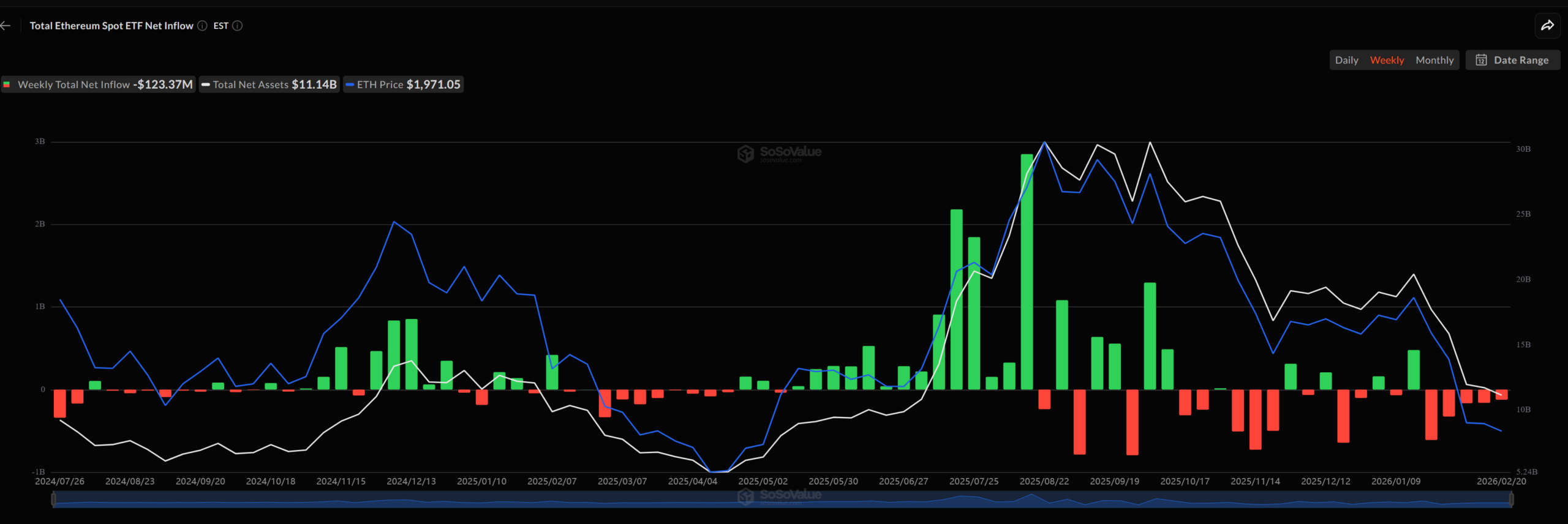
US spot Bitcoin exchange-traded funds (ETFs) have experienced a sustained period of investor withdrawal, marking five consecutive weeks of net outflows that have collectively seen approximately $3.8 billion pulled from these investment products. This trend persisted through last week, with the funds recording about $315.9 million in net outflows, according to data compiled by SoSoValue. The most significant weekly withdrawal within this five-week streak occurred in the week ending January 30, when spot Bitcoin (BTC) ETFs saw a substantial net outflow of approximately $1.49 billion.
Despite the overall negative trend, some trading sessions within the past week did witness inflows. On Friday, Bitcoin ETFs registered about $88 million in net inflows. However, these positive movements were overshadowed by larger redemption days earlier in the week. Notably, February 12 saw withdrawals exceeding $410 million, and further negative sessions were recorded from February 17 through February 19, ultimately contributing to a firmly negative weekly total.
Since their inception, spot Bitcoin ETFs have accumulated a total of roughly $54.01 billion in net inflows as of Friday. The total net assets managed by these funds currently stand near $85.31 billion, representing approximately 6.3% of Bitcoin’s overall market capitalization. This recent outflow period follows a generally positive trajectory since the launch of these products.

Institutional De-Risking Drives Bitcoin ETF Outflows
Analysts suggest that the recent withdrawals from spot Bitcoin ETFs are more indicative of institutional investors adjusting their portfolios rather than a sign of waning long-term interest in Bitcoin. Vincent Liu, Chief Investment Officer at Kronos Research, posits that these outflows reflect a broader trend of portfolio de-risking in response to rising geopolitical tensions and general macroeconomic uncertainty.
Liu further anticipates that flows into these ETFs may remain volatile in the short term. Escalating trade disputes and developments concerning tariffs have contributed to a risk-off environment across global markets, making digital assets particularly sensitive to macroeconomic news and events.
"Market inflows will be dependent on macro events like incoming Thursday’s initial jobless claims, as weaker data could revive expectations for future rate cuts and help support sentiment currently at 14 extreme fear on the crypto fear and greed index," Liu stated, highlighting the influence of economic indicators on investor sentiment.

Spot Ether ETFs Also Experience Outflows
The pressure of outflows is not confined to Bitcoin. Spot Ether (ETH) ETFs have also encountered sustained selling pressure, with flows turning negative across the past five weeks. Investors have been trimming their exposure to the second-largest cryptocurrency by market capitalization.
During the past week, Ether ETFs recorded approximately $123.4 million in net outflows, according to SoSoValue data. These weekly losses occurred despite some days experiencing positive inflows. For instance, Ether ETFs saw inflows on several days, including about $48.6 million on February 17 and $10.3 million on February 13. However, these positive sessions were insufficient to counteract the heavier selling experienced earlier in the week.
The sustained outflows from both spot Bitcoin and Ether ETFs underscore a period of cautious sentiment among institutional investors, driven by broader macroeconomic concerns and geopolitical instability. While the long-term outlook for digital assets remains a subject of ongoing analysis, current market dynamics point to a phase of reduced risk appetite, influencing investment decisions in the cryptocurrency ETF space. The performance of these ETFs will likely continue to be closely monitored for any shifts in institutional sentiment and as indicators of broader market trends.