 11
11 1
1 2
2 3
3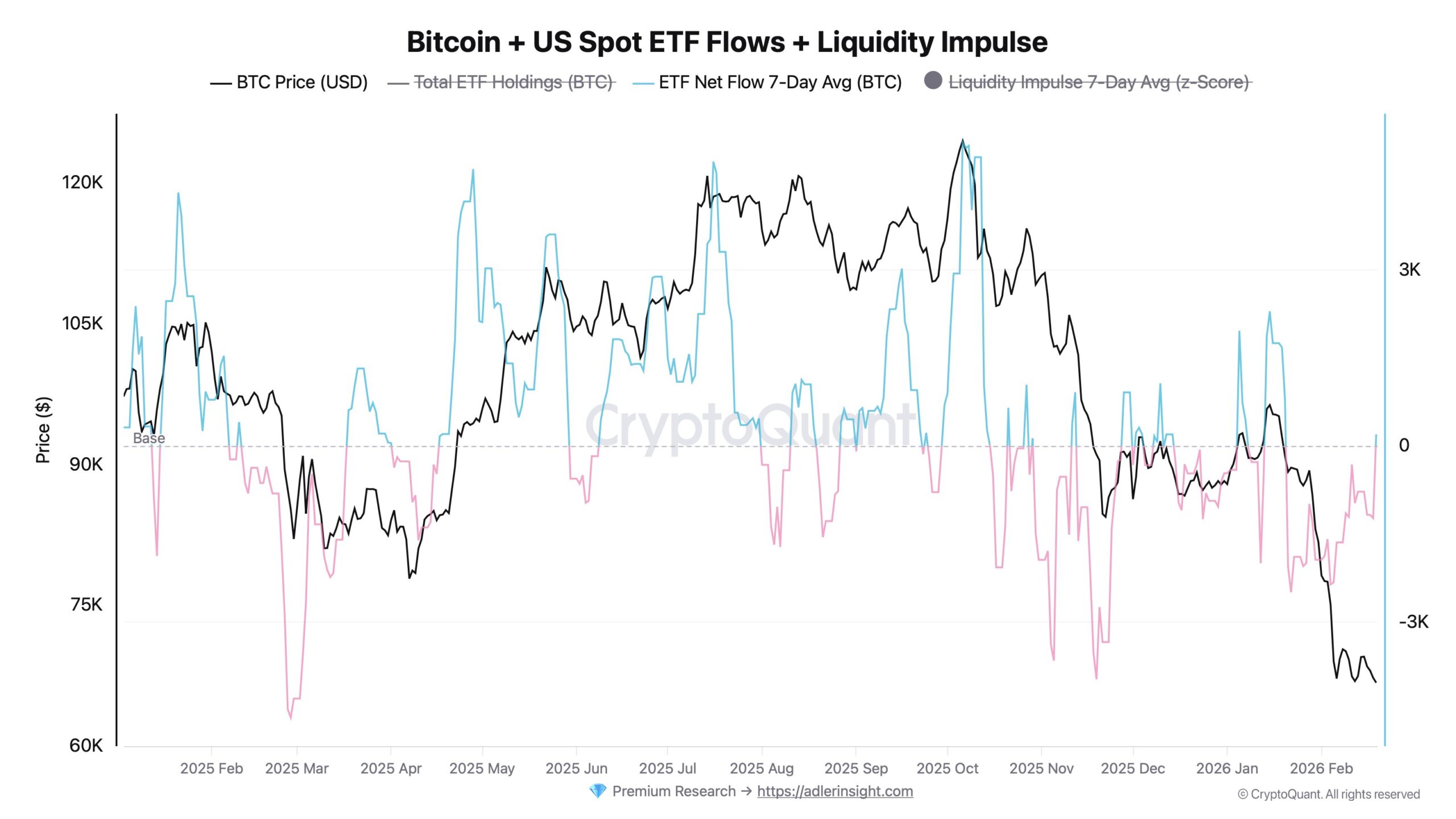
Spot Bitcoin exchange-traded funds (ETFs) are on the cusp of recording a fourth consecutive month of net outflows, mirroring a broader bearish sentiment in the cryptocurrency market as Bitcoin (BTC) approaches its fifth negative monthly close in February. This sustained outflow trend is clearly demonstrated by the diminishing fund balances and bearish rolling net flow data, particularly when juxtaposed with the performance of competing asset ETFs. The ongoing decline in Bitcoin’s price and spot ETF holdings, which began in October, has prompted investors to scrutinize the future trajectory of BTC.

The narrative surrounding Bitcoin ETFs has been dominant in financial news. In October 2025, the net assets held within U.S. spot Bitcoin ETFs reached a peak of nearly $170 billion. However, this figure has since fallen to $84.3 billion. Cumulatively, net inflows have decreased to approximately $54 billion from an all-time high of $63 billion. Since July 2025, cumulative net flows have totaled a mere $5 billion, a stark indicator of the significant reduction in capital entering these investment vehicles.
Bitcoin researcher Axel Adler Jr. meticulously tracked ETF activity between February 12 and February 19, identifying net outflows totaling 11,042 BTC across seven trading sessions. The most substantial single-day reduction occurred on February 12, with outflows amounting to 6,120 BTC, equivalent to roughly $416 million. The sessions on February 17 and February 18 also witnessed consecutive outflows of 1,520 BTC and 1,980 BTC, respectively. Only two sessions within this period registered positive inflows; the February 6 session saw an addition of 5,900 BTC to the ETF holdings. Adler emphasized that a minimum of three consecutive positive sessions would be required to signal a renewed accumulation phase within the ETFs. Until such a trend is established, the ongoing outflows are contributing to market supply.

Macroeconomic data further supports this cooling trend. Since November 2025, Bitcoin ETFs have divested approximately 87,000 BTC, with roughly 15,000 BTC being shed in February alone. The total ETF balances now stand at approximately 1.26 million BTC, a noticeable decrease from the peak of 1.36 million BTC. The selling pressure originating from the largest Bitcoin funds has been quantifiable. BlackRock’s IBIT holdings, for instance, have seen a reduction from 806,000 BTC to 759,000 BTC, a 6% decrease. Fidelity’s FBTC experienced a more pronounced decline, dropping from 213,000 BTC to 186,000 BTC, representing a 12.6% decrease. Despite these outflows from major ETFs, Bitcoin’s price has fallen more sharply than the ETF balances, suggesting that spot market demand has been insufficient to fully absorb the broader market pressure.
In a notable shift, gold ETFs appear to be capturing investor attention, effectively stealing the spotlight from Bitcoin ETFs. Over the past two years, Bitcoin and gold ETFs have seen a rotation in leadership based on 90-day rolling flows. Bitcoin’s 90-day inflows peaked near $16 billion in March 2024, subsequently moderating to between $3 billion and $4 billion from June to October, before surging to $21.6 billion in December 2024.

Gold ETFs, in contrast, followed a different trajectory. Their flows remained negative until July 2024, after which they accelerated significantly, reaching $30 billion by April 2025. During March and April 2025, Bitcoin’s 90-day flows dipped into negative territory, registering at -$2 billion. Gold experienced another peak in inflows at $36 billion in October 2025, while Bitcoin’s inflows began to fade in the final quarter of the year. By January 2026, gold flows had reached $29 billion, easing to $21 billion by mid-February, while Bitcoin flows remained consistently negative. This data reveals a recurring pattern of capital shifting between the two assets. Periods of weakening demand for Bitcoin ETFs have coincided with surges in gold inflows, particularly evident between March and October 2025. In relative terms, gold ETFs have attracted incremental capital as investors sought refuge in an asset characterized by smaller price volatility and a longer, established track record during periods of market uncertainty or "risk-off" sentiment.
The current market environment is being characterized as a "late-cycle restrictive digestion" phase for both equity and crypto markets, according to Benjamin Cowen, founder of ITC Crypto. This assessment is informed by the persistent macroeconomic conditions. Although the U.S. Federal Reserve concluded its quantitative tightening program in December 2025, thereby halting the runoff of its balance sheet, monetary policy remains restrictive when measured against market growth expectations. The federal funds rate continues to exceed the 2-year Treasury yield, and the 10-year yield is trading near 4.1%, with the 10-year real yield hovering around 1.7%-1.8%. These elevated yields contribute to tight financial conditions.

The presence of positive real yields means that investors can achieve inflation-adjusted returns within fixed-income markets. This presents a higher opportunity cost for holding non-yielding assets like Bitcoin. Cowen’s historical analysis indicates that in previous tightening cycles, Bitcoin’s price often experienced a downturn before broader equity markets showed signs of stress. For example, in 2019, BTC’s price began to decline months before the general weakness in equities became apparent. Historically, sustained ETF inflows have typically followed periods of falling real yields or a clear easing cycle in monetary policy. As neither of these conditions has yet materialized, it provides a potential explanation for the observed slowdown in demand for Bitcoin ETFs since October 2025. The current market dynamics suggest that investors are prioritizing assets offering tangible returns and stability in a restrictive financial environment, leading to a redirection of capital away from speculative, non-yielding digital assets.