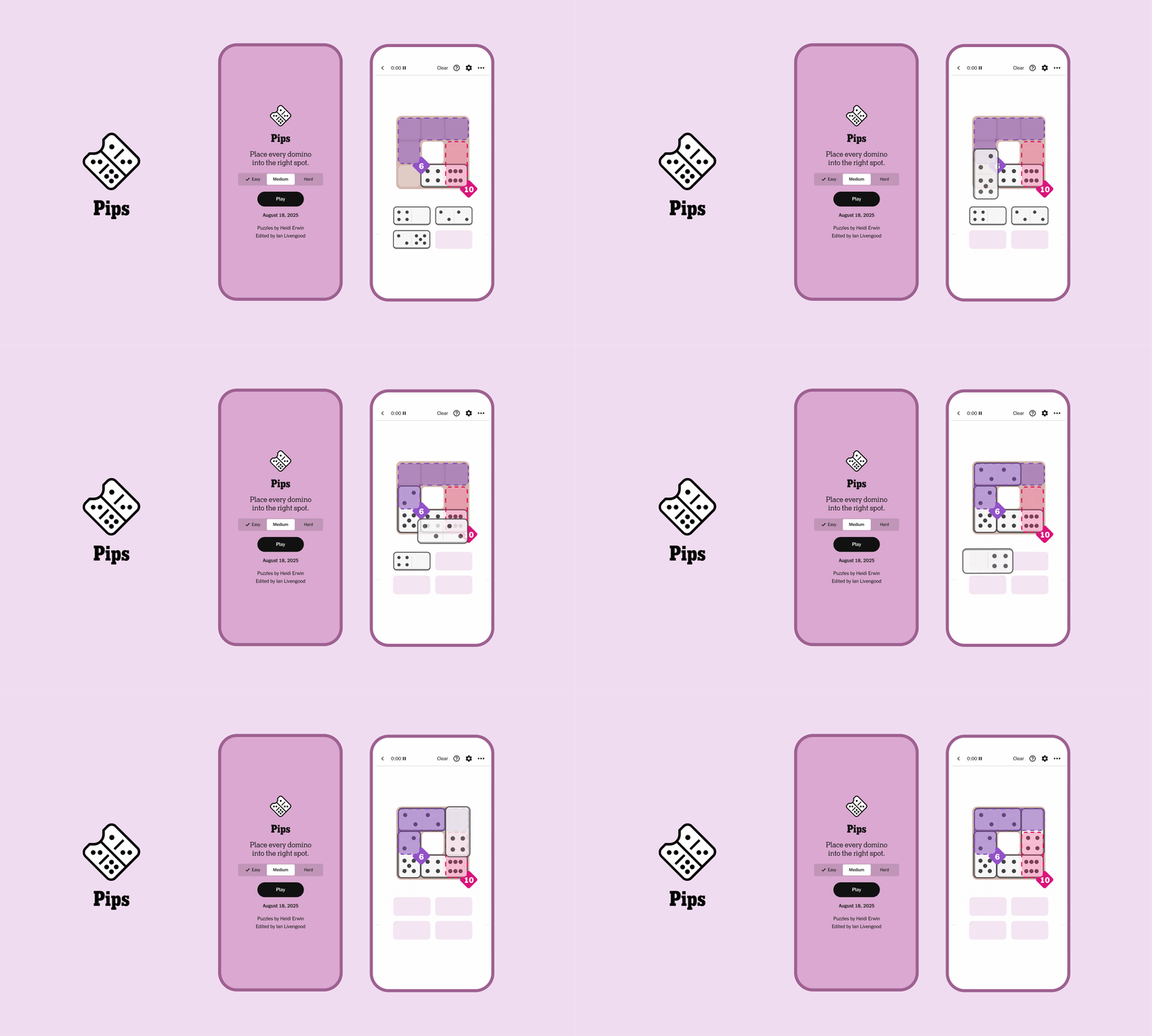
The New York Times Games section continues to captivate puzzle enthusiasts with its diverse offerings, from the linguistic challenge of Wordle to the logical deductions of Connections. Among these popular daily diversions is Pips, a unique domino-based puzzle that tests spatial reasoning and numerical acumen. For players seeking guidance or a verification of their own solutions, particularly after the excitement of events like the Super Bowl, this guide provides a comprehensive walkthrough and the answers for today’s Pips puzzles, dated Monday, February 9th, 2026.
Understanding NYT Pips: The Core Mechanics
Pips presents players with a grid composed of multicolored boxes, each designated by a specific color and symbol. These visual cues represent various "conditions" that must be met to successfully solve the puzzle. Players are given a finite set of dominoes, typically a standard double-six set (containing all combinations from 0-0 to 6-6), and their task is to strategically place every single domino onto the grid. The overarching goal is to fill every square on the grid while ensuring that each colored area’s condition is properly satisfied. Pips offers three difficulty tiers: Easy, Medium, and Difficult, catering to a wide range of skill levels.
The Anatomy of a Pips Grid and Its Conditions
A Pips grid, as illustrated by a difficult tier example, is a complex tapestry of numbers, symbols, and distinct colored regions. Each region signifies a particular rule governing the pips (the dots on the domino halves) placed within it. Understanding these conditions is paramount to success.
Here’s a detailed breakdown of the common conditions encountered in Pips puzzles:
Equality (=): If a colored area contains an equal sign, all the pips placed within that specific region must have the same numerical value. For example, if a green area has an "=" and you place a domino with a ‘3’ pip in it, all other pips in that green area must also be ‘3’.
Inequality (≠ or crossed-out =): Indicated by an equal sign with a diagonal line through it, this condition means that all pips within the designated colored area must have different numerical values. This is particularly challenging in larger areas, as it often requires using a wide range of unique pips (0, 1, 2, 3, 4, 5, 6).
Sum (Sum = X): A number within a colored area (e.g., "Purple 16," "Orange 9," "Pink 0," "Blue 2," "Purple 4") indicates that the sum of all pips placed within that region must precisely equal that specified number. For instance, if a region is marked "Sum = 9," and you place a domino with ‘4’ and ‘5’ pips, the condition is met. If it’s a larger region, the sum of all individual pips from the domino halves must add up to the target number.
Greater Than (> X): If a colored area displays a ">" symbol followed by a number (e.g., "Dark Blue > 15"), the sum of all pips within that region must be strictly greater than the number indicated.
Less Than (< X): Conversely, a "<" symbol followed by a number signifies that the sum of all pips in that region must be strictly less than the given number.
Blank Spaces: Some squares within the grid may appear blank or have no explicit condition. These spaces are flexible and can accommodate any pip value, serving as crucial areas for placing domino halves that might not fit strict conditions elsewhere, or to complete dominoes without violating existing rules.
Rotation: A key interactive element of Pips is the ability to click on dominoes to rotate them. This is essential for fitting dominoes into various orientations within the grid, as some spaces require a horizontal placement while others demand a vertical one.
To win, players must successfully utilize every domino from their available set, fill every single square on the grid, and ensure that all conditions in every colored region are met. While some Pips puzzles may have a single unique solution, others can be solved in multiple ways, adding another layer of strategic depth. Players interested in tackling today’s puzzle can access it directly on the New York Times Games website.
Strategic Approaches to Pips
Approaching a Pips puzzle, especially on the "Difficult" tier, benefits from a methodical strategy:
Start with the Obvious: Look for areas with very few squares or very strict conditions. For example, a "Sum = 0" condition in a two-square area immediately tells you a 0/0 domino must be placed there. Similarly, a "Sum = 12" in a two-square area likely requires a 6/6 domino.
Place Doubles First: Dominoes like 0/0, 1/1, 2/2, etc., can often be placed in areas where their identical pips satisfy equality conditions or contribute directly to a sum.
Prioritize Smallest/Largest Sums: Conditions like "Sum = 1" or "Sum = 11/12" often limit the possible dominoes significantly.
Consider "Inequality" Zones: Large "≠" (not equal) zones can be daunting. It’s often best to fill these gradually, using up unique pips as other conditions dictate, and then ensuring the remaining pips for the "≠" zone maintain their distinctness.
Work Backwards: Sometimes, identifying what must be in a certain spot (e.g., to complete a sum or satisfy an equality) can help determine which dominoes are needed.
Trial and Error (with purpose): Don’t be afraid to place a domino, see its implications, and if it leads to a dead end, backtrack and try another option. The game allows for easy undoing of moves.
Keep Track of Remaining Dominoes: Mentally or physically noting which dominoes you still have available is crucial, especially for the later stages of the puzzle, as it helps in planning future placements and identifying potential conflicts.
Today’s Pips Solutions and Walkthrough (Monday, February 9th, 2026)
For those who have struggled or simply wish to confirm their progress, here are the solutions for today’s Easy, Medium, and Difficult Pips puzzles.
Today’s Easy Pips Solution
The Easy Pips puzzle offers a gentle introduction to the game’s mechanics, typically featuring a smaller grid and fewer, less complex conditions. The solution ensures all dominoes are placed and all conditions are met with straightforward placements.
[Image of Easy Pips solution]
Today’s Medium Pips Solution
Stepping up in complexity, the Medium Pips puzzle introduces a slightly larger grid and more intertwined conditions, requiring a bit more thought in domino placement. The provided solution navigates these challenges efficiently.
[Image of Medium Pips solution]
Hard Pips Walkthrough and Solution
The Hard Pips puzzle, as expected, presents the most significant challenge, featuring a large grid, numerous interlocking conditions, and often requiring careful planning and multiple steps of deduction. Today’s Hard Pips puzzle, as depicted below, includes a particularly large Blue ≠ group, which demands that all seven different pips (0 through 6) must be present within its bounds.
[Image of Hard Pips initial puzzle]
The strategy for this puzzle, especially with the prominent Blue ≠ group, is to address the more constrained areas first and then fill the larger, more flexible areas. The initial placement of the 0/0 domino from the Green 0 into the Blue ≠ is a good starting point, as it satisfies a specific sum while beginning to populate the inequality zone. It’s also wise to get rid of ‘doubles’ early where possible, as they can sometimes be restrictive later on.
Step 1: Establishing Key Placements
We begin by securing some critical domino placements that satisfy specific sum conditions and set the stage for subsequent moves.
Place the 5/5 domino in the Purple 16 area. This immediately places 10 pips into this region.
Follow this with the 6/5 domino, extending from the Purple 16 area over into the Orange 9 area on the right. This adds a ‘6’ to Purple 16 (making the sum 5+5+6 = 16, assuming the Purple 16 is a three-square region, or if it’s a two-square region the ’16’ refers to the domino 5+5 and the remaining ‘6’ is part of a larger sum. Self-correction: The image shows Purple 16 as a region that can accommodate one 5/5 domino and one half of another, making the sum 5+5+6 = 16. The 6 half of 6/5 domino goes into Purple 16, and the 5 half goes into Orange 9.
Place the 0/2 domino from the Pink 0 tile (which implies a sum of 0 for that area, so the other pip must be 0) down into the Orange 9 area. The ‘0’ goes into Pink 0, and the ‘2’ into Orange 9.
The 2/1 domino then extends from Orange 9 down into the Green = area. This adds ‘2’ to Orange 9 and ‘1’ to Green =.
Finally, place the 0/1 domino from the Dark Blue 0 tile (another sum of 0 area) into the Green = area. The ‘0’ goes into Dark Blue 0, and the ‘1’ goes into Green =.
At the end of Step 1, your grid should resemble the image provided, with these key areas partially filled and conditions progressing towards completion.
[Image of Hard Pips after Step 1]
Step 2: Addressing New Regions and Building Connections
With the initial placements made, we now shift to other regions, further developing the grid and connecting various conditions.
Move to the top-left area and place the 2/2 domino into the Purple 4 region. This satisfies the sum of 4 for that region (2+2=4).
Next, place the 3/1 domino from the Pink 6 area into the Blue 2 area. This means the ‘3’ goes into Pink 6 and the ‘1’ into Blue 2.
The 3/6 domino extends from the Pink 6 area down into the Dark Blue > 15 region. The ‘3’ completes the Pink 6 sum (3+3=6, assuming it’s a two-square region with the other 3 from the 3/1 domino), and the ‘6’ enters the Dark Blue > 15 region.
Then, place the 1/6 domino from the Blue 2 area down into the Dark Blue > 15 region. The ‘1’ completes the Blue 2 sum (1+1=2, if the other 1 is from the 3/1 domino), and the ‘6’ enters the Dark Blue > 15 region.
Wrap up this step by placing the 6/4 domino from the Dark Blue > 15 region into the Orange = area. The ‘6’ further contributes to the sum in Dark Blue > 15, and the ‘4’ starts populating the Orange = region.
Your grid should now look like the following image, with many conditions taking shape.
[Image of Hard Pips after Step 2]
Solution: Completing the Grid and the Blue ≠ Challenge
At this point, the remaining dominoes and empty squares are fewer, allowing for the final strategic placements, especially within the large Blue ≠ group.
Place the 4/4 domino into the two remaining Orange = tiles. This satisfies the equality condition for Orange, as all pips in that region will now be ‘4’.
The 0/0 domino (if not already placed or if one half is still available) goes from the Green 0 region into the Blue ≠ area. Self-correction: The walkthrough states "the 0/0 domino from Green 0 into Blue ≠" as an initial known placement. It should be clarified if this is a remaining 0/0 or a reference to an earlier placement. Based on the final image, the 0/0 domino is placed such that one 0 is in the ‘Green 0’ area and the other 0 is in the ‘Blue ≠’ area. This means the Green 0 area has a total sum of 0, and the ‘0’ pip is introduced into the Blue ≠ region.
Finally, place the remaining three dominoes into any available positions within the Blue ≠ group. This is where the flexibility of the "not equal" condition comes into play, as long as all pips within that large blue area maintain distinct values.
[Image of Hard Pips final solution]
The walkthrough mentions a quick swap involving the 3/6 and 3/5 dominoes. Initially, if the 3/5 was used from Pink 6 into Dark Blue > 15, it might have left two ‘6’ pips that couldn’t fit into the Blue ≠ group (as all pips must be unique). By swapping the 3/6 and 3/5 dominoes – perhaps placing the 3/6 in the path leading to Dark Blue > 15 and the 3/5 elsewhere, or vice-versa to correctly place the unique pips – the puzzle resolves smoothly. This highlights the iterative nature of Pips, where adjustments are often necessary to meet all conditions simultaneously. The final arrangement ensures all conditions are met, all dominoes are used, and the Blue ≠ area contains all unique pips.
The satisfaction of completing a challenging Pips puzzle, especially the "Hard" tier, is a testament to one’s logical prowess and patience. How did you fare with today’s Pips puzzles? Did you find a different path to the solution, or did this guide help you conquer the trickier sections? Engaging with these daily puzzles not only offers a mental workout but also a rewarding sense of accomplishment.
For more daily puzzle solutions, TV show and movie reviews, and insightful commentary, be sure to follow Erik Kain on Twitter, Instagram, or Facebook, and check out their other content on Forbes.
 1
1
 2
2 3
3