 11
11 1
1 2
2 3
3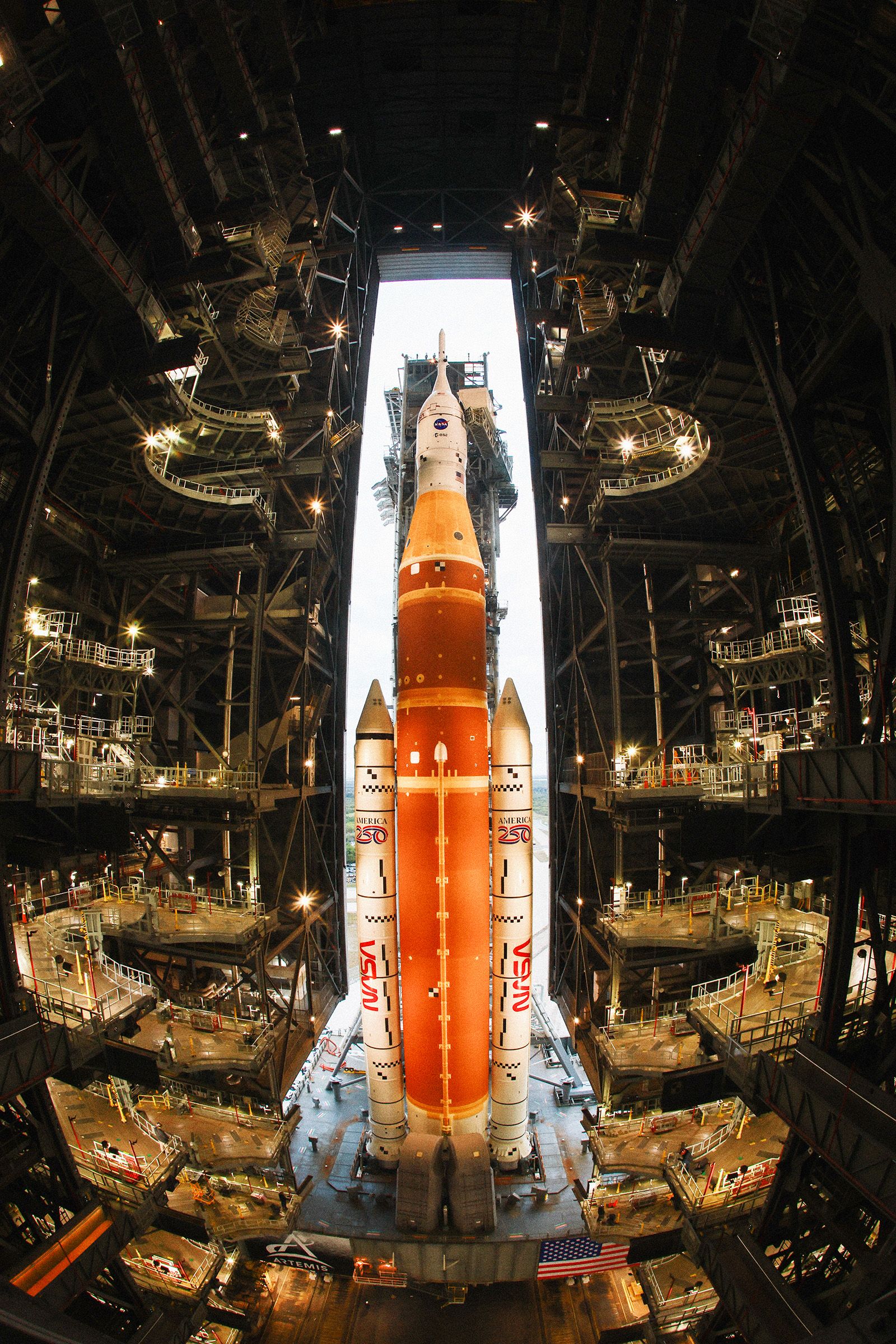
NASA Administrator Jared Isaacman announced a comprehensive restructuring of the Artemis lunar exploration program on Friday morning, signaling a dramatic shift in the agency’s approach to returning humans to the Moon. The sweeping changes include a mandate for an increased cadence of missions and the cancellation of the costly Exploration Upper Stage (EUS) rocket component, a move intended to streamline operations and accelerate progress.
This significant upheaval comes at a critical juncture for NASA, which has faced considerable challenges in the Artemis program. Most notably, the agency has grappled with persistent difficulties in fueling the colossal Space Launch System (SLS) rocket for the eagerly anticipated Artemis II crewed lunar mission. These technical hurdles, coupled with what Isaacman described as a "glacial pace" in deep-space programs, have fueled growing concerns within the space community and among policymakers. A primary driver behind these reforms is the escalating geopolitical competition, with increasing apprehension that China’s rapidly advancing space program could achieve a human lunar landing before NASA can re-establish a continuous human presence on the Moon within this decade via Artemis.
"NASA must standardize its approach, increase flight rate safely, and execute on the president’s national space policy," Isaacman asserted during his announcement. He emphasized the urgency of the situation, stating, "With credible competition from our greatest geopolitical adversary increasing by the day, we need to move faster, eliminate delays, and achieve our objectives." This declaration underscores a renewed focus on efficiency, reliability, and strategic competition in space.
Shaking Things Up: A New Direction for Artemis
At the core of Administrator Isaacman’s concerns is the unacceptably low flight rate of the SLS rocket and, consequently, the Artemis missions. Historically, during foundational exploration programs such as Mercury, Gemini, Apollo, and the Space Shuttle era, NASA maintained an average launch rate for crewed missions of approximately once every three months. In stark contrast, nearly three and a half years have elapsed since the uncrewed Artemis I mission successfully launched, highlighting a significant slowdown in operational tempo.
"This is just not the right pathway forward," Isaacman stated, reflecting the agency’s frustration with the current pace. A senior NASA official, who spoke on background to Ars Technica, corroborated these concerns, noting the recurring hydrogen and helium leaks during both Artemis I and Artemis II prelaunch preparations. These technical glitches alone have resulted in monthslong delays, further exacerbating the program’s slow progression. "If I recall, the timing between Apollo 7 and 8 was nine weeks," the official remarked, drawing a sharp contrast to current schedules. "Launching SLS every three and a half years or so is not a recipe for success. Certainly, making each one of them a work of art with some major configuration change is also not helpful in the process, and we’re clearly seeing the results of it, right?"

The new strategy aims to rectify this by standardizing the SLS rocket into a single, consistent configuration. This standardization is projected to enhance the rocket’s reliability and enable a significantly accelerated launch schedule, targeting a launch frequency of approximately every 10 months. NASA plans to continue utilizing the SLS vehicle until viable commercial alternatives emerge for transporting crews to the Moon. This commitment extends potentially through Artemis V, as mandated by Congress, and possibly even beyond, depending on the maturation of commercial capabilities.
Key Programmatic Shifts
The most impactful change announced is the cancellation of the Exploration Upper Stage (EUS), a contract worth billions of dollars primarily held by Boeing. The EUS was designed to be a more powerful upper stage for the SLS Block 1B configuration, intended to boost heavier payloads to the Moon and beyond. Its first launch was anticipated later this decade. Despite the significant financial implications for its prime contractor, Boeing appeared to express at least conditional support for the revised plans in a NASA news release. Steve Parker, Boeing Defense, Space & Security president and CEO, stated, "Boeing is a proud partner to the Artemis mission and our team is honored to contribute to NASA’s vision for American space leadership. The SLS core stage remains the world’s most powerful rocket stage, and the only one that can carry American astronauts directly to the moon and beyond in a single launch. As NASA lays out an accelerated launch schedule, our workforce and supply chain are prepared to meet the increased production needs."
This decision necessitates a new approach for future Artemis missions requiring greater payload capacity. For the Artemis IV lunar landing mission and subsequent flights, NASA will need to procure and human-rate a new commercial upper stage for the SLS rocket. The vehicle currently relies on a modified Delta IV upper stage, manufactured by United Launch Alliance. However, that production line has been closed, leaving NASA with only two remaining units. With the EUS cancelled, NASA will now seek a "standardized" commercial upper stage. Industry observers, including Ars Technica, have previously reported that the Centaur V upper stage, currently flying on United Launch Alliance’s Vulcan rockets, is the most likely replacement candidate due to its proven capabilities and availability.
Solid Reasons for Changing Artemis III
The revised approach for Artemis also reflects a strategic return to the meticulous, step-by-step philosophy that characterized the successful Apollo program. In the late 1960s, NASA executed a series of preparatory crewed missions before the historic Apollo 11 lunar landing. These included Apollo 7, a low-Earth-orbit test of the Apollo spacecraft; Apollo 8, a seminal lunar orbiting mission; Apollo 9, a low-Earth-orbit rendezvous with the lunar lander; and Apollo 10, a crucial test of the lunar lander’s descent to the Moon without actual touchdown.
Under its previous Artemis template, NASA had opted to skip many of these intermediate steps. The plan involved an ambitious leap from Artemis II – a crewed lunar flyby designed primarily to test the SLS rocket and Orion spacecraft – directly to Artemis III, which was intended to be a full-scale human lunar landing. Many industry officials viewed this expedited sequence as an "enormous and risky" undertaking.

The new, more incremental approach will, in NASA’s parlance, "buy down" some of the inherent risks associated with a 21st-century lunar landing. This includes crucial testing of lunar lander performance and handling, rendezvous and docking procedures, communication systems, advanced spacesuit performance, and various other operational complexities. However, this revised strategy also presents new challenges for NASA. In particular, the timeline for preparing the Orion spacecraft for a mid-2027 launch will require significant acceleration. Furthermore, substantial effort will be needed to integrate the Orion vehicle with the chosen lunar lander providers, which will now likely involve more rigorous testing phases.
Is Everyone on Board?
According to the senior NASA official, all of the agency’s key contractors have expressed their agreement with these significant changes. Furthermore, senior leaders in Congress have been thoroughly briefed on the proposed modifications and are reportedly on board. This broad consensus suggests a shared understanding of the need for reform and a commitment to adapting the program for greater success.
What About the Lunar Gateway?
Friday’s announcement, which resonated through the space community with the impact of a major earthquake, left several critical details unaddressed. One such area of uncertainty concerns the fate of the larger launch tower being developed to support the Block 1B version of the SLS rocket, which was designed to accommodate the more powerful EUS. The development of this tower has been plagued by considerable cost overruns and delays, with project costs ballooning from an initial estimate of $383 million to an exorbitant $1.8 billion. The question of whether this expensive infrastructure will be scrapped or repurposed remains unanswered.
Administrator Isaacman and other NASA officials also remained notably silent regarding the Lunar Gateway, a proposed space station intended for a high orbit around the Moon. Key elements of this ambitious space station are currently under construction. However, the cancellation of the Exploration Upper Stage raises pertinent questions about the Gateway’s future, as the Block 1B version of SLS was primarily intended to launch its heavier modules alongside the Orion spacecraft.
"The whole Gateway-moon base conversation is not for today," the senior NASA official stated, indicating that further discussions are pending. "We, I can assure you, will talk about the moon base in the weeks ahead. I would just not overly read into this, because we had manifested some Gateway modules on Falcon Heavy already. The implications of standardizing SLS and increasing launch rate are about the ability to return to the moon. I don’t think we necessarily have to speculate too much on what the other downstream implications are."

The Gateway program office is currently headquartered at Johnson Space Center in Houston, where it is envisioned as a successor to the International Space Station in terms of flight operations. Prominent politicians, such as Senator Ted Cruz, a Republican from Texas, have historically been strong proponents of this new lunar station. However, during recent congressional hearings, Senator Cruz has indicated an openness to either a lunar space station or an outpost directly on the lunar surface, emphasizing his primary goal for NASA to establish an enduring presence on or near the Moon. An industry source suggested that Isaacman might be laying the groundwork to potentially replace the Gateway Program with a dedicated Moon Base program office in Houston. The potential for a political battle over this shift remains to be seen.
Some of This Has Been Well Predicted
While the changes outlined by NASA on Friday are undoubtedly sweeping in scope, they are not entirely unexpected within the space industry. As early as April 2024, Ars Technica reported that some senior NASA officials were actively considering an Earth-orbit rendezvous between the Orion spacecraft and SpaceX’s Starship as a viable means to mitigate risk for a lunar landing. NASA initially deferred action on this concept, but it has now been revived under Isaacman’s leadership.
Furthermore, in October 2024, Ars Technica published a detailed guide outlining strategies to revitalize the "floundering" Artemis program. This analysis specifically recommended canceling the Block 1B upgrade for the SLS rocket, replacing its upper stage with a Centaur V, and canceling the Lunar Gateway. The publication estimated that these measures could free up an estimated $2 billion annually, which could then be redirected towards accelerating a human lunar landing.
It appears that the space agency has indeed embarked upon a course of action that closely aligns with many of these prescient recommendations, signaling a pivotal moment for the future of American lunar exploration.
This story originally appeared on Ars Technica.