 11
11 1
1 2
2 3
3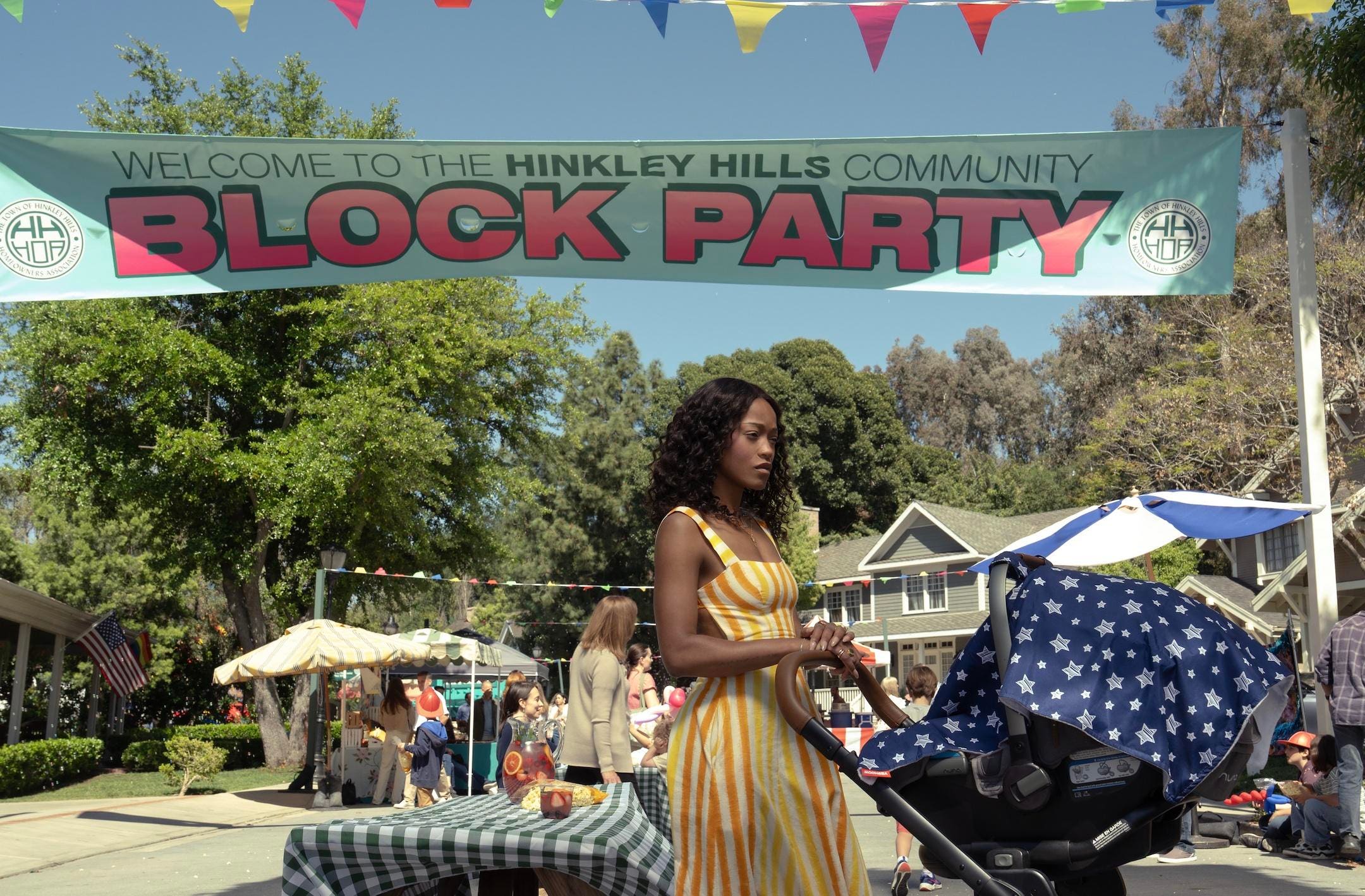
Keke Palmer, celebrated for her distinctive flair and magnetic personality, is once again poised to captivate audiences in her latest venture, Peacock’s new horror-comedy series, The ‘Burbs. Fans and critics alike eagerly anticipate Palmer’s every move, and her role in this project promises to deliver the unique blend of entertainment and introspection she’s known for. This fresh take on the cult-classic 1989 film of the same name, helmed by creator Celeste Hughey, reimagines suburban dread for a contemporary audience, infusing it with layers of psychological intrigue, societal reflection, and poignant humor.
The series transports viewers to present-day suburbia, where the seemingly idyllic facade of suburban life quickly crumbles to reveal mysterious secrets and underlying horror. At its core, The ‘Burbs follows the newly married couple, Samira, portrayed by the dynamic Keke Palmer, and Rob, played by Jack Whitehall. Their journey begins as they reluctantly trade their vibrant cosmopolitan apartment for Rob’s childhood home in the quiet, unassuming community of Hinkley Hills, accompanied by their newborn son, Miles. This relocation marks a significant shift, particularly for Samira, a formidable civil litigation lawyer grappling with the unfamiliar territory of maternity leave and the creeping boredom that often accompanies it. Isolated in her new surroundings, Samira endeavors to assimilate into her new life and forge connections with the eccentric neighbors who populate her cul-de-sac.
As Samira tentatively navigates her new social landscape, she becomes acquainted with a colorful cast of characters, including the widowed Lynn (Julia Duffy), the former Marine Dana (Paul Pell), and the wonderfully zany Tod (Mark Proksch). However, her initial comfort soon gives way to unease as she discerns that her husband, Rob, harbors far more knowledge than he lets on about the old pink Victorian house across the street and the unsettling events that transpired there involving its former resident. This realization ignites Samira’s inherent inquisitiveness, characteristic of her legal background, prompting her to delve deeper into the neighborhood’s hidden narratives.
Over the course of the series, Samira’s investigation into the abandoned Victorian and the broader secrets of Hinkley Hills intensifies. What she ultimately uncovers is a decades-long secret that not only shatters the town’s tranquility but also compels her to re-evaluate every aspect of her new existence: her environment, her marriage, and her standing within the seemingly close-knit community. The narrative skillfully weaves together elements of a delicious psychological thriller with moments of genuine humor, taking viewers on an emotional rollercoaster that challenges perceptions and unearths uncomfortable truths.

Beyond its thrilling plot, The ‘Burbs distinguishes itself through its thoughtfully crafted narrative, which, according to creator, writer, and executive producer Celeste Hughey, is deeply rooted in contemporary themes. Hughey, celebrated for her work on critically acclaimed projects such as Dead to Me, High Fidelity, and Palm Springs, emphasized the intentional grounding of the story in racial tension and the gradual, often challenging, process of community-building through trust. "It was important for me when adapting the series to really keep that essence [of the film] in the DNA of the show alive, but still create our own story and our own characters," Hughey shared in a Zoom interview. "There were so many timely themes in the movie that still resonate today."
Hughey further elaborated on her vision for the series, highlighting the deliberate choice to center the story around an outsider’s perspective. "I wanted to show the perspective of an outsider, so I wanted to center the story on a Black woman in a white suburban neighborhood, and what that experience is," she explained. This decision allowed for an exploration of the unique challenges and nuances of such a transition, while ultimately demonstrating how the character could "still be able to find community and find family, despite not being sure whether or not she would be welcomed." This thematic thread promises to resonate deeply with audiences, offering a fresh lens through which to view suburban life and belonging.
For Hughey, Keke Palmer was not just an actress for the role but the very embodiment of her character. "Keke was always exactly who I saw as the star," Hughey affirmed, showering Palmer with praise. "To me, she’s the next generation of Tom Hanks. She’s funny and can do the dramatic scenes, too. She’s just charming and undeniable and has charisma that you can’t take your eyes off of." Hughey revealed the profound connection she felt to Palmer’s talent, stating, "I wrote this series as a love letter to Keke. I was thinking in her voice, and I wanted to create a character that was worthy of the star that we all love, who can do the full range of comedy and drama and carry the emotional weight of a complex character, but bring lightness and fun to that as well." This profound admiration between creator and star undoubtedly translated into a performance that is both authentic and captivating.
The commitment to authenticity extended to the minutiae of Samira’s portrayal, a detail Hughey painstakingly ensured throughout the series. Collaborating with series writer Amy Aniobi and director Nzingha Stewart, Hughey integrated specific cultural touchstones that underscore Samira’s identity and heritage, even as she navigates a predominantly white environment. "There are details throughout the series that I thought were important to include," Hughey shared. "I mean, you see her walking down the street with her bonnet. I haven’t seen that on TV in a very long time, and it was important for me to put that she’s wearing a Howard University sweatshirt, like that. She’s in this white neighborhood, but she never loses sight of who she is, and we demonstrate this through the art on her walls and her relationship with her brother." These visual and narrative cues, complemented by Stewart’s thoughtful inclusion of a "beautiful quilt on the bed, which would have been from her grandmother," collectively create a rich tapestry of Samira’s character, emphasizing her deep-rooted identity amidst new surroundings. "To hold all these moments, and they were all so thoughtful, and I’m glad that you were able to see that and feel that, because that was always our intention," Hughey reflected, highlighting the collaborative effort to craft a truly nuanced protagonist.
Keke Palmer, in turn, expressed immense admiration for Hughey’s creative prowess and her ability to tackle complex narratives with sensitivity and depth. "Celeste had a great history of working on Dead to Me, so I knew she was going to be playing with big themes, but still finding a way to ground it and make it accessible and enduring for people to watch," Palmer remarked. She drew parallels to iconic television, noting, "I think about classic shows like The Jeffersons and any of Norman Lear’s shows, big themes were being talked about and discussed, but it was something you could stomach, and you could feel like, ‘Okay, I could see a way out of this at the end.’ I think that’s always what I’m hoping to give people with my work." This perspective underscores Palmer’s commitment to projects that not only entertain but also provoke thought and offer a sense of hope or understanding.

Embracing the challenge of both playing Samira and reimagining a beloved cult classic, Palmer clarified her approach to the project. "I’m not trying to be Tom Hanks, and we’re not trying to make that movie, but we do want to pay homage and kind of open it up to a different audience," she stated. Her role as Samira is a distinct creation, utilizing the horror-comedy genre in innovative ways. "I play an entirely new character with a completely different set of ways that she’s using the genre, from the satire that we use to open up the clichés of these archetypal characters that you think you know, to the horror that arises when you become a new mom, and when your relationship no longer looks the way that you thought it looked." Palmer views both comedy and horror as powerful vehicles for exploration. "I look at genre, both comedy and horror, as a place to explore that stuff in a way that is exciting and not necessarily predictable, and fun in a unique way," she elaborated, indicating a sophisticated understanding of genre as a tool for deeper storytelling.
Palmer also found profound personal resonance in her character’s journey, particularly in Samira’s experience as a devoted new mother navigating maternity leave. She drew easy parallels to the often-unseen realities of postpartum life. "It was just about being truthful to the fact of what happens after you have a baby, where everything becomes so heightened, so not underwriting the reality that what Samira is picking up on is correct, but the way in which she’s going about it, and how that lends itself for us to make commentary on postpartum, I think was big," Palmer revealed. She highlighted a common misconception, stating, "A lot of people think that postpartum is this thing that’s obvious to the person that’s enduring it, and it’s not. It’s like readjusting your mind to the idea that you have something significant outside your body, and then everything becomes an emergency. So watching her deal with what that looks like was very cathartic for me to play because it humanized that experience." This candid reflection from Palmer adds another layer of depth to Samira’s character, making her struggles and discoveries all the more relatable.
Beyond the personal journey of motherhood, Palmer emphasized another crucial takeaway from the series: the invaluable importance of community. "I took from this series that community is everything, and you can find community in the strangest of places, so just be open," she advised. Samira’s initial assumptions about her new town and the town’s preconceptions about her gradually dissolve as they discover shared humanity. "I think Samira has ideas coming into this town, and people have ideas about her coming into this town, but they find themselves on common ground: we actually all need each other, and we should be looking out for each other," Palmer concluded, encapsulating the series’ optimistic message about connection and mutual support.
The ‘Burbs promises to be a compelling addition to Peacock’s lineup, offering a smart, genre-bending narrative that is both entertaining and socially relevant. With Keke Palmer’s dynamic performance at its heart and Celeste Hughey’s thoughtful storytelling, the series is poised to spark conversations while delivering genuine thrills and laughs. All eight episodes of The ‘Burbs are set to premiere on February 8 on Peacock.