 11
11 1
1 2
2 3
3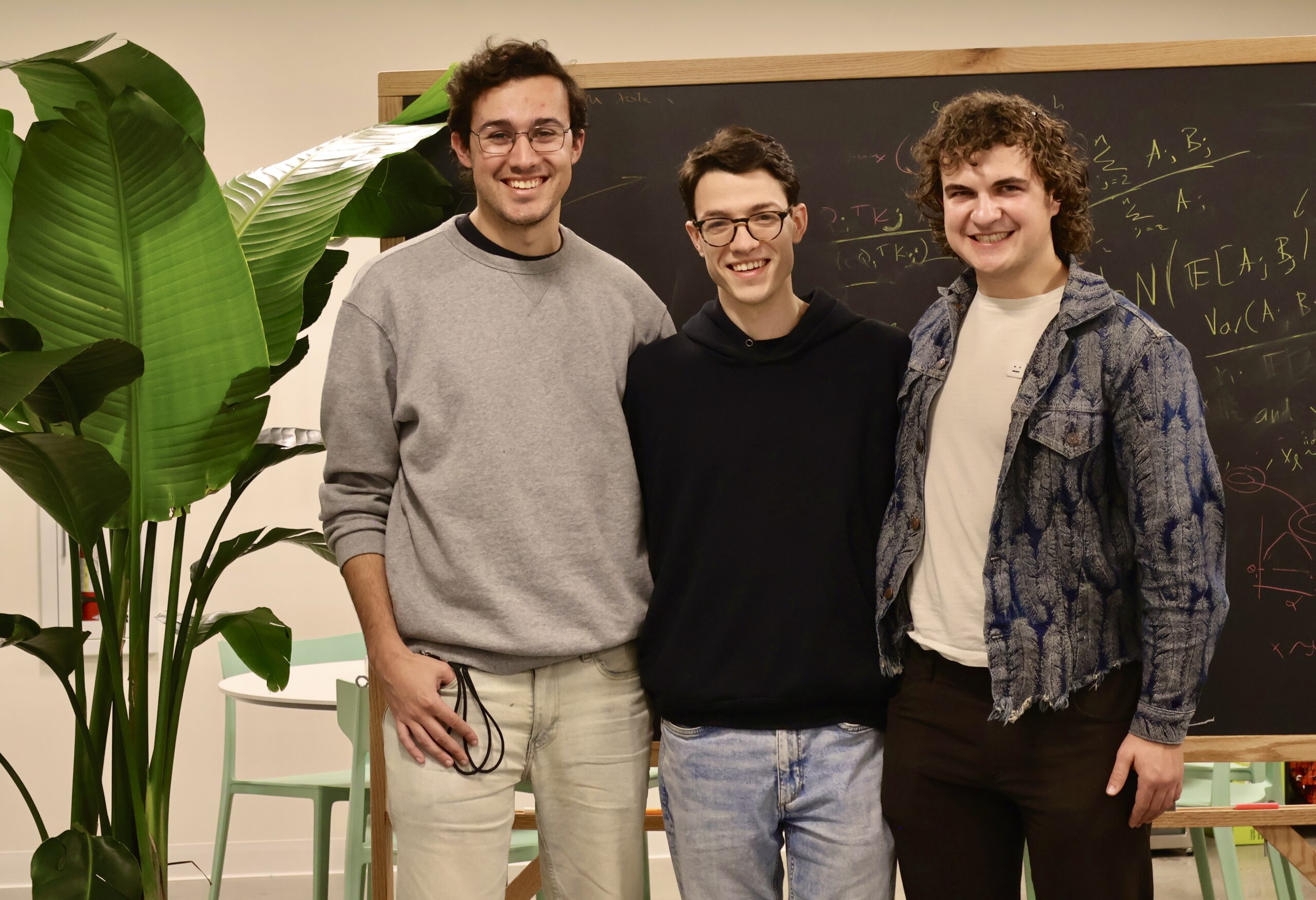
Boston, MA – June 23, 2026 – Flapping Airplanes, a burgeoning AI research laboratory, has emerged as a significant player in the rapidly expanding landscape of research-focused AI initiatives. Propelled by its young and inquisitive founders, brothers Ben and Asher Spector, and Aidan Smith, the company is dedicated to exploring novel, less data-intensive methods for training artificial intelligence. This ambitious endeavor, which seeks to fundamentally reshape the economics and capabilities of AI models, has successfully garnered a substantial $180 million in seed funding, providing the team with considerable resources to pursue their vision.
In an exclusive interview last week at a TechCrunch event in Boston, the three co-founders discussed the opportune timing for launching a new AI lab and their recurring fascination with the intricate workings of the human brain.
A New Frontier: Beyond Data-Hungry Models
Addressing the prevailing sentiment that the AI landscape is dominated by giants like OpenAI and DeepMind, Ben Spector articulated Flapping Airplanes’ distinct approach. "There’s just so much to do," he stated, acknowledging the "spectacular" advances of the past five to ten years while emphasizing that these achievements do not represent the "whole universe of things that needs to happen." For Flapping Airplanes, the "data efficiency problem" stands out as the crucial area for investigation. Current frontier models, he explained, are "trained on the sum totality of human knowledge," a stark contrast to humans who "can obviously make do with an awful lot less." This significant disparity, Ben believes, is "worth understanding."
The company’s strategy is underpinned by a concentrated bet on three core tenets: first, that data efficiency is a vital, solvable, and commercially valuable problem; second, that achieving this will significantly improve the world; and third, that a "creative and even in some ways inexperienced team" is best suited to tackle these challenges from the ground up.
Aidan Smith reinforced this perspective, stating that Flapping Airplanes does not perceive itself as directly competing with other major labs. "We think that we’re looking at just a very different set of problems," he explained. He highlighted the fundamental divergence between how the human mind learns and how current transformer models operate. While Large Language Models (LLMs) excel at memorization and drawing upon vast knowledge, they require "rivers and rivers of data to adapt" and struggle to quickly acquire new skills. The algorithms employed by the human brain, he noted, are "fundamentally so different from gradient descent and some of the techniques that people use to train AI today." This recognition drives their mission to cultivate "a new guard of researchers" who can approach the AI space with fresh thinking.
Asher Spector added a scientific and commercial dimension to their pursuit. He described the core question of why human and artificial intelligent systems differ so profoundly as "scientifically interesting." Simultaneously, he sees immense commercial viability and societal benefit in their work. "Lots of regimes that are really important are also highly data constrained, like robotics or scientific discovery," Asher explained. He posited that a model a "million times more data efficient is probably a million times easier to put into the economy." This dual appeal—scientific intrigue and practical application—motivated their fresh perspective.
The Brain as an Existence Proof, Not a Blueprint
The company’s name, "Flapping Airplanes," subtly hints at their philosophical stance on AI development, particularly regarding neuromorphic AI. Aidan Smith, with his background at Neuralink, offered his view of the brain not as a direct model to be replicated, but as an "existence proof." It demonstrates that "there are other algorithms out there," challenging the prevailing "orthodoxy" in AI. He acknowledged the "crazy constraints" of biological hardware, such as the millisecond it takes for an action potential to fire, during which computers can perform countless operations. This suggests that an approach "much better than the brain out there, and also very different than the transformer," is likely possible. While deeply "inspired by some of the things that the brain does," Flapping Airplanes emphasizes that they are not "tied down by it."
Ben Spector elaborated on the "Flapping Airplanes" analogy. He likened current large-scale AI systems to "big, Boeing 787s." Their goal, he clarified, is not to build "birds"—a direct biological imitation—but "some kind of a flapping airplane." Drawing from his computer systems background, Ben noted that the "constraints of the brain and silicon are sufficiently different from each other that we should not expect these systems to end up looking the same." The vastly different trade-offs in compute cost, locality, and data movement naturally lead to divergent system architectures. However, this difference does not negate the value of drawing inspiration from the brain to enhance their own systems.
Research-First, with an Eye on Commercialization
In an era where many AI labs oscillate between pure research and product development, Flapping Airplanes firmly positions itself as research-focused for the foreseeable future. Asher Spector admitted the inability to provide a timeline for commercial breakthroughs. "We don’t know the answers. We’re looking for truth," he stated. Despite this, all founders possess commercial backgrounds and are "excited to commercialize" their innovations, believing it beneficial to disseminate created value. Their current priority, however, is clear: "We just need to start by doing research, because if we start by signing big enterprise contracts, we’re going to get distracted, and we won’t do the research that’s valuable."
Aidan Smith emphasized their commitment to exploring "really, really radically different things," acknowledging that such approaches might initially prove "worse than the paradigm" but hold long-term potential for different trade-offs. Ben Spector underscored the importance of focus for startups. While large companies can multitask, startups must "pick what is the most valuable thing you can do, and do that all the way." For Flapping Airplanes, this means being "all in on solving fundamental problems for the time being." He expressed optimism that substantial progress might soon enable them to "touch grass in the real world" and gain invaluable feedback. Ben credits the recent shift in AI funding economics for allowing companies to maintain this research focus for longer, fostering "differentiated work."
Navigating a Hot Funding Landscape
The company’s success in securing $180 million in seed funding is a testament to both their vision and the current investor appetite for groundbreaking AI research. Ben Spector described the fundraising process as a mixture of expectation and surprise. While aware of the "hot" market for large rounds, he noted that "you never quite know how the fundraising environment will respond to your particular ideas." The process itself offered learning opportunities, allowing them to refine their priorities and commercialization timelines.
Ben expressed genuine surprise at how well their message resonated with investors. "It was something that was very clear to us, but you never know whether your ideas will turn out to be things that other people believe as well or if everyone else thinks you’re crazy," he reflected. They were "extremely fortunate to have found a group of amazing investors who our message really resonated with and they said, ‘Yes, this is exactly what we’ve been looking for.’" Aidan Smith characterized this as a "thirst for the age of research" that Flapping Airplanes is uniquely positioned to pursue with its radical ideas.
Compute Costs: A Paradox of Deep Research
Addressing concerns about the enormous compute costs typically associated with foundation models, Ben Spector offered a somewhat paradoxical view. "One of the advantages of doing deep, fundamental research is that, somewhat paradoxically, it is much cheaper to do really crazy, radical ideas than it is to do incremental work," he explained. Incremental advancements often require extensive scaling to validate, making them expensive. In contrast, a truly novel architecture or optimizer, if flawed, will likely fail quickly at a small scale, thus being cheaper to disprove.
While acknowledging that "scale is actually an important tool," Ben clarified that Flapping Airplanes is not "the antithesis of scale." Instead, their approach allows them to test "many of our ideas at very small scale before we would even need to think about doing them at large scale." Asher Spector succinctly added, "you should be able to use all the internet. But you shouldn’t need to," highlighting their perplexity that human-level intelligence currently necessitates such vast data consumption.
The Promise of Data-Efficient AI
The founders outlined several hypotheses for what becomes possible with vastly improved data efficiency. Asher Spector presented three potential outcomes:
Ben Spector expanded on the broader societal impact, moving beyond the "deflationary technology" view of AI automating jobs. While acknowledging that automation will occur, he emphasized a more exciting vision: "one where there’s all kinds of new science and technologies that we can construct that humans aren’t smart enough to come up with, but other systems can." The focus on creativity and deep insight, rather than mere memorization, is crucial for achieving these "new advances in medicine and science." His mission is to enable AI to "do stuff that, like, fundamentally humans couldn’t do before," transcending mere job replacement.
Navigating the AGI Conversation
On the topic of Artificial General Intelligence (AGI), Asher Spector expressed a pragmatic perspective. "I really don’t exactly know what AGI means," he admitted, while acknowledging rapid advancements and economic value creation. He dismissed notions of an imminent "God-in-a-box" or a singularity within "two months or even two years" that would render humans obsolete. Instead, he reiterated Ben’s point: "it’s a really big world. There’s a lot of work to do."
Aidan Smith further clarified their view on the brain’s role in this discussion, stating, "the brain is not the ceiling, right? The brain, in many ways, is the floor." He posited that the brain, as a knowable system operating under physical constraints, is not the ultimate limit. They anticipate creating capabilities "much, much more interesting and different and potentially better than the brain in the long run." Asher added that comparing AI to the brain helps understand "how big the space is," preventing the misconception that "we like, have the answer. We’re almost done."
Ben Spector stressed that their aim is not to be "better, per se," but to be "different." He acknowledged that all systems will involve trade-offs, offering advantages in some areas and costs in others. Given the vast array of domains with diverse needs, "having more system, and more fundamental technologies that can address these different domains is very likely to make the kind of AI diffuse more effectively and more rapidly through the world."
Cultivating a Culture of Creativity and Unorthodoxy
Flapping Airplanes distinguishes itself through its unique hiring strategy, actively seeking out exceptionally young talent, including individuals still in college or even high school. Aidan Smith explained that they look for individuals who "dazzle you, they have so many new ideas and they think about things in a way that many established researchers just can’t because they haven’t been polluted by the context of thousands and thousands of papers." Creativity is their top priority, fostering an environment where "radical solutions" to AI’s big problems can be dreamed up.
Ben Spector’s personal hiring criterion is simple: "do they teach me something new when I spend time with them?" If so, he believes they are likely to contribute new insights to their work. Drawing from his experience with a startup incubator, Prod, Ben noted that "young people can absolutely compete in the very highest echelons of industry." He emphasized that a crucial "unlock" is simply realizing one’s capability to contribute at the highest level. While valuing experienced professionals and having hired some, their core mission resonates most with those "not afraid to change the paradigm and can try to imagine a new system of how things might work." Unorthodox backgrounds are welcomed; "You don’t need two PhDs. We really are looking for folks who think differently."
Anticipating a "Weird" Future for AI
When asked about the ultimate nature of the AI systems they envision, Asher Spector predicted a future far beyond incremental improvements. He referenced the "strange emerging capabilities" of the GPT-4 base model, where it could identify an author from an unwritten blog post snippet. "Future models will be smarter in even stranger ways," he asserted. Aiming for "1000x wins in data efficiency" rather than incremental change, he expects "the future to be really weird and the architectures to be even weirder," leading to "unknowable, alien changes and capabilities at the limit."
Ben Spector largely agreed, albeit with a slightly more tempered view on how these capabilities would be presented to consumers, similar to how OpenAI refined the GPT-4 base model. Nevertheless, he affirmed that their research agenda is unequivocally focused on building "capabilities that really are quite fundamentally different from what can be done right now."
For those interested in engaging with Flapping Airplanes, the company provides two direct email addresses: [email protected] for general inquiries and [email protected] for those wishing to challenge their ideas. "We’ve actually had some really cool conversations where people, like, send us very long essays about why they think it’s impossible to do what we’re doing," Asher shared, though Ben quickly added, "But they haven’t convinced us yet. No one has convinced us yet." Additionally, they actively seek "exceptional people who are trying to change the field and change the world" to join their team, particularly those with unorthodox backgrounds and a propensity for innovative thought.