 11
11
Bitcoin (BTC) is currently exhibiting a significant undervaluation when compared to both gold and the global money supply, a situation that could foreshadow a substantial price reversal, according to Samson Mow, the CEO of Bitcoin technology firm Jan3. Mow articulated this perspective in a recent post on the social media platform X, where he stated, "Bitcoin is about 24%-66% below its trend relative to gold’s market cap or global money supply, while gold is overextended."
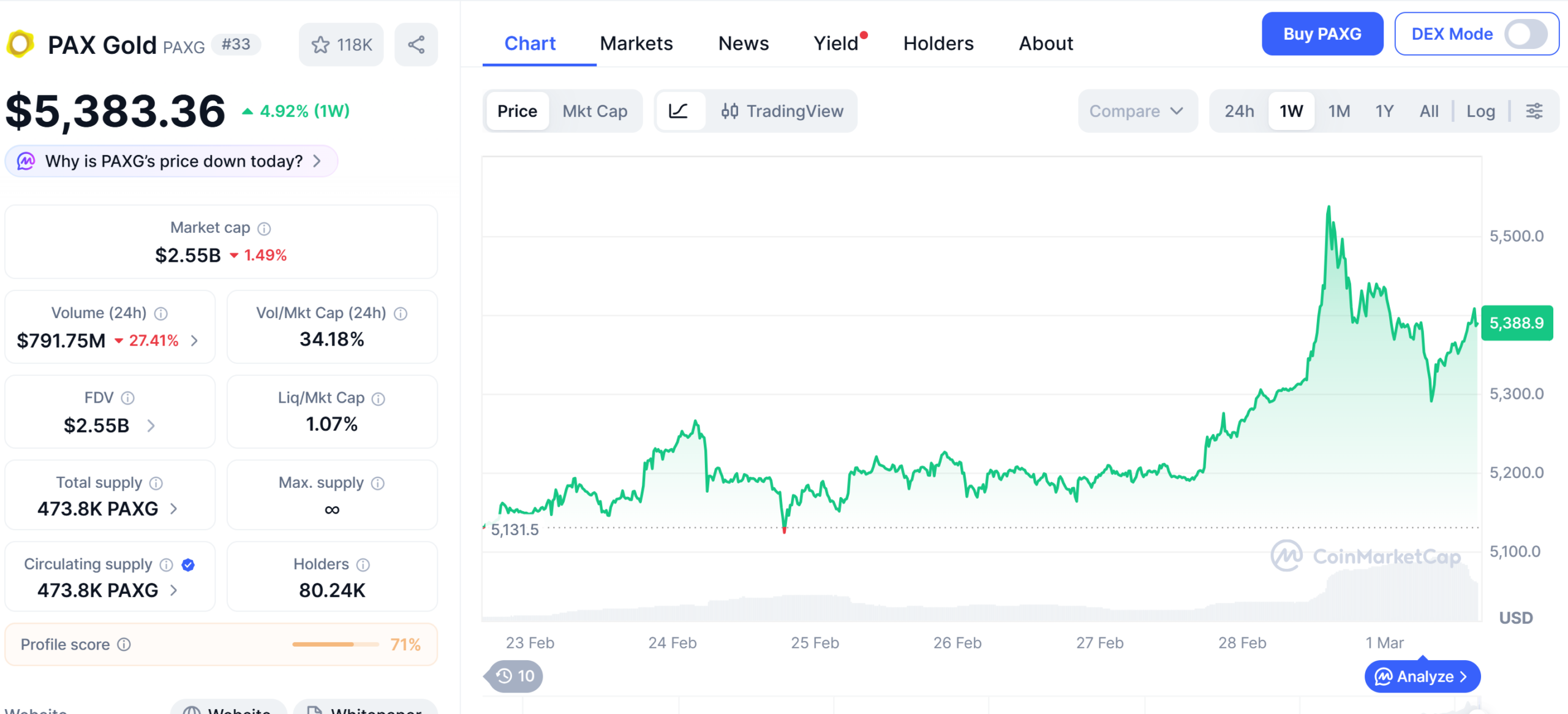
At the time of Mow’s statement, gold futures for April delivery had closed the preceding Friday at $5,247.90. In parallel, tokenized gold, represented by PAX Gold USD, was trading around $5,404.14. This comparison highlights a divergence where gold’s market valuation appears inflated relative to historical trends, while Bitcoin, conversely, is trading at a discount.
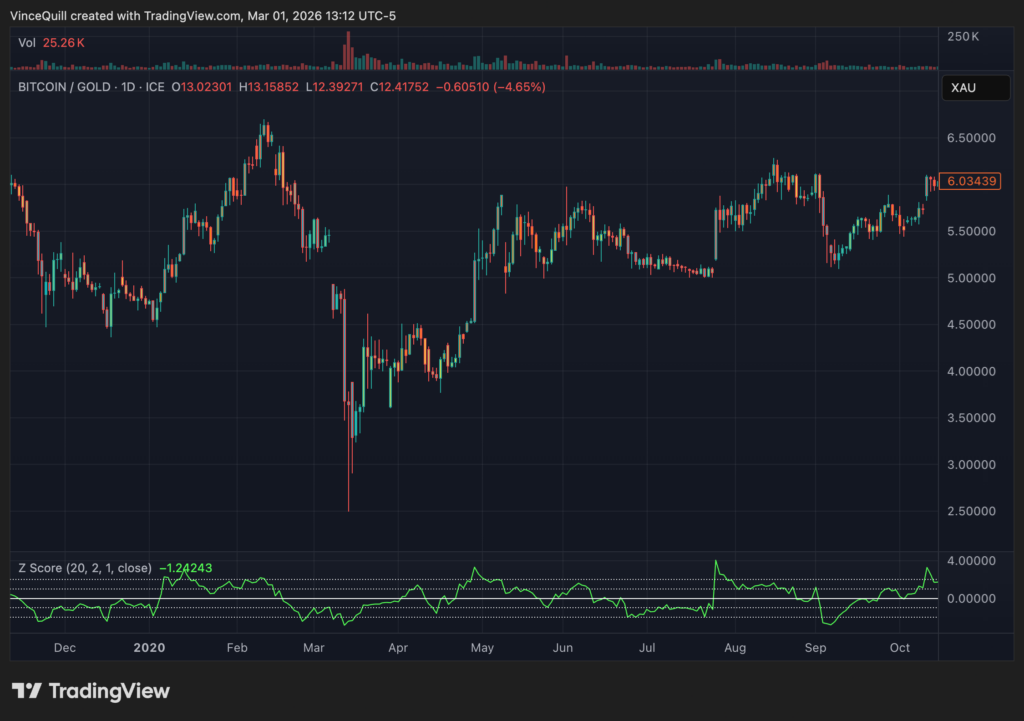
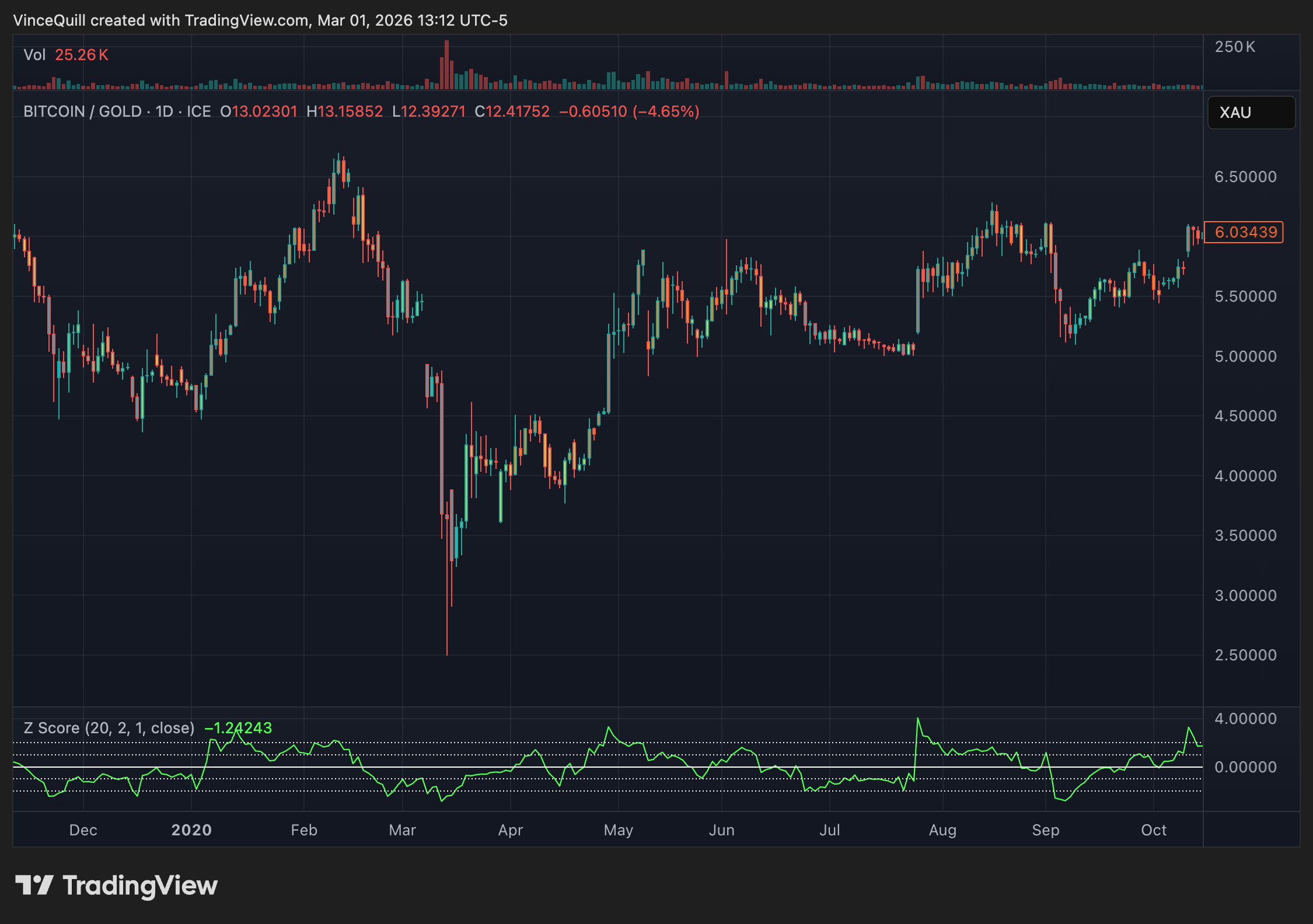
To further support his assertion of Bitcoin’s undervaluation, Mow referenced the Z-score metric applied to the Bitcoin-to-gold ratio. The Z-score is a statistical measure used to assess how far a data point is from its historical average, expressed in terms of standard deviations. A Z-score of 0 indicates that the price is precisely in line with its historical average. A Z-score above 0 suggests the price is trending above average, while a Z-score below 0 indicates the price is trading below the average.

The Z-score of the Bitcoin-to-gold ratio, as depicted in charts from TradingView, has historically shown a strong correlation with significant price movements in Bitcoin. Mow pointed out that when this Z-score dips below -2, Bitcoin has historically experienced "major" price rallies. At the time of writing, the Z-score for the BTC-to-gold ratio was approximately -1.24. While this current reading is not below the critical -2 threshold, its position suggests a potential for a rebound.
Further historical data from TradingView reinforces Mow’s theory. In November 2022, amidst the catastrophic collapse of the cryptocurrency exchange FTX, the Z-score of the Bitcoin-to-gold ratio plummeted below -3. This period of extreme undervaluation was swiftly followed by a remarkable surge in Bitcoin’s price, which rallied by over 150% in the subsequent 12 months. This historical event serves as a powerful precedent for the potential impact of a low Z-score.
A similar pattern of dramatic price appreciation following a significant Z-score drop was observed earlier in March 2020, during the onset of the COVID-19 pandemic. At that time, the Z-score of the Bitcoin-to-gold ratio also fell below -2. Bitcoin reached a cyclical low of approximately $3,717 during this period. In the ensuing 12 months, Bitcoin experienced an extraordinary surge of over 300%, culminating in its then-all-time high of around $69,000 by November 2021. These historical instances underscore the predictive power of the Z-score in identifying potential inflection points for Bitcoin’s price.
Mow’s analysis presents a distinctly contrarian viewpoint when contrasted with other market observers. A segment of crypto market analysts is forecasting further downward pressure on the digital asset market, predicting a potential decline in Bitcoin prices. These bearish outlooks are attributed to prevailing investor uncertainty and escalating geopolitical tensions, which are contributing to a cautious sentiment across financial markets.

Some analysts suggest that Bitcoin’s price trajectory might be mirroring the dynamics of the 2022 bear market, with projections indicating a potential descent towards the $50,000 mark. This perspective is informed by the recent price action, where Bitcoin experienced a significant pullback of over 50% from its peak to a low of approximately $60,000, before staging a limited recovery to its current levels, hovering near $66,400. This recovery occurred in the wake of significant developments in the Middle East over the preceding weekend, which injected a degree of volatility into global markets.
The current market sentiment, as reflected by various indicators, suggests a degree of caution among investors. However, Mow’s analysis, rooted in the comparative valuation of Bitcoin against gold and global money supply, coupled with the historical significance of the Z-score, offers a compelling argument for potential upside. The assertion that Bitcoin is undervalued relative to these established benchmarks suggests that the digital asset may possess considerable room for growth, particularly if market dynamics revert to historical patterns observed during periods of extreme Z-score deviation. The sustained undervaluation, as indicated by Mow’s data, implies that current price levels may not fully reflect Bitcoin’s intrinsic value or its potential as a store of value and medium of exchange in the long term.
The comparison with gold is particularly salient, given gold’s historical role as a safe-haven asset and a hedge against inflation and economic uncertainty. If Bitcoin is indeed significantly undervalued relative to gold’s market capitalization, it suggests that Bitcoin could be poised to capture a greater share of the global store-of-value market. Furthermore, its comparison to the global money supply provides a broader context for its potential expansion. As the global economy continues to evolve and traditional financial systems face ongoing challenges, assets like Bitcoin, which are perceived as scarce and decentralized, may attract increasing capital inflows, especially when trading at a discount to their perceived fundamental value. The historical rallies following periods of extreme undervaluation, as evidenced by the Z-score’s performance during the FTX collapse and the COVID-19 crash, provide a strong foundation for the expectation of a future price reversal. The market will be closely watching to see if Bitcoin can indeed capitalize on its current undervaluation and embark on a significant upward trend, as suggested by Mow’s insightful analysis.