 11
11 1
1 2
2 3
3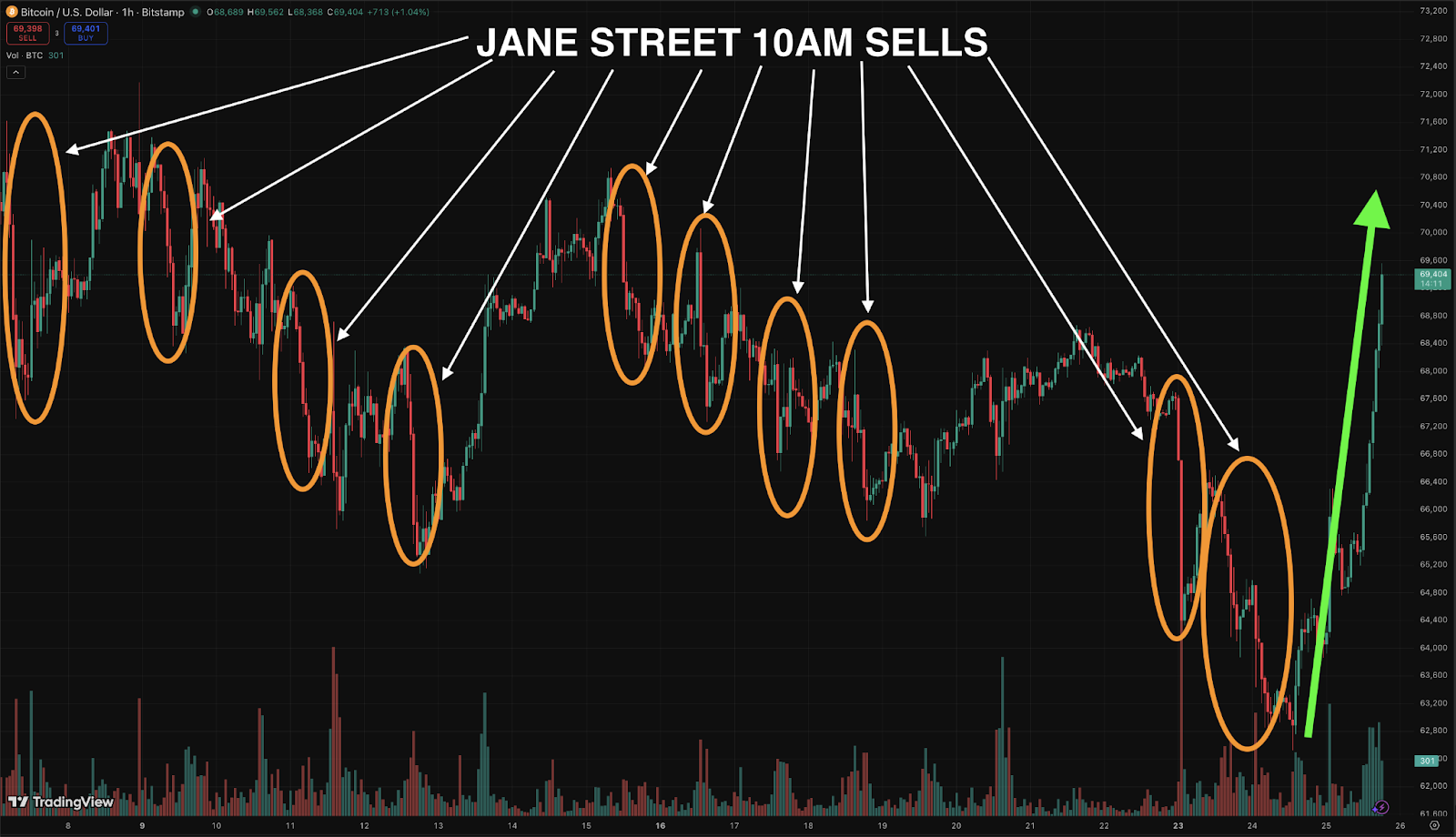
Cryptocurrency investors have leveled accusations against quantitative trading firm Jane Street, alleging that the firm orchestrates a daily, programmatic selloff of Bitcoin at the opening of the US market to influence its price. However, market analysts and available data suggest that this purported pattern is inconsistent and that no single entity possesses the power to force Bitcoin into a prolonged bear market. These claims gained traction online shortly after the court-appointed administrator for Terraform Labs initiated a lawsuit against Jane Street, alleging insider trading linked to transactions that exacerbated the collapse of Terra’s algorithmic stablecoin ecosystem in May 2022.

The controversy was ignited by several market observers, including crypto influencer Justin Bechler. Bechler posited that Jane Street’s significant holdings in BlackRock’s iShares Bitcoin Trust exchange-traded fund (ETF), known as IBIT, could potentially mask a net short Bitcoin position through hedging strategies that are not transparent in public filings. Bechler argued that Jane Street was allegedly engaging in coordinated algorithmic selling of Bitcoin at precisely 10:00 am Eastern Time each day, a maneuver intended to manipulate the Bitcoin (BTC) price downwards, thereby enabling the firm to acquire ETF shares at a discounted rate.
Bechler elaborated on this theory via social media, stating, "When Jane Street reports holding $790 million in IBIT shares, the filing tells you nothing about whether those shares are hedged by puts, offset by short futures, or wrapped in a collar that makes the firm’s net Bitcoin exposure zero or even negative." He further contended that "the actual position could be a massive short," which, despite appearing as a long position in public disclosures, would remain "invisible" under current reporting regulations.

However, this narrative has been met with caution from industry experts. Julio Moreno, head of research at CryptoQuant, advised that the trading activity described by Bechler is not exclusive to a single firm. Moreno explained that the practice of acquiring spot exposure while simultaneously selling futures is a common strategy employed by delta-neutral funds. These funds aim to profit from market spreads rather than from directional price movements.
Jane Street’s most recent 13-F filing not only disclosed its stake in IBIT but also revealed holdings in Strategy, along with substantial positions in Bitcoin mining companies such as Bitfarms, Cipher Mining, and Hut 8. This broad portfolio indicates a diversified investment strategy that extends beyond a singular focus on Bitcoin price manipulation.

The online discourse primarily centers on the observation that Bitcoin’s price frequently experiences a decline shortly after 10:00 am ET, a timeframe that coincides with the commencement of US trading hours. Onchain analyst Nonzee shared an hourly Bitcoin chart, asserting that Jane Street had been "manipulating" the market at this specific time for several months. Similarly, the crypto market watcher account Whale Factor claimed that Bitcoin consistently registered a daily drop of 2% to 3% within minutes of the US market opening, alleging a programmatic manipulation that has been ongoing since early November. Whale Factor further suggested that Jane Street’s substantial investment in BlackRock’s IBIT, exceeding $2.5 billion, was the likely catalyst for these alleged "engineered liquidity sweeps to accumulate spot #ETF’s at a discount."
Contrarian views have emerged from macro analysts who dispute this interpretation. Alex Krüger, a macro analyst, presented blockchain data indicating that Bitcoin has recorded cumulative returns of 0.9% between 10:00 am and 10:30 am ET since January 1st. Krüger argued that this data does not support the notion of a "systemic dump." He stated, "Everyone says Bitcoin dumps at 10 AM every day. I pulled the data, and it’s not true," suggesting that the observed price action is more indicative of a broader risk-asset repricing that mirrors the performance of the Nasdaq stock index.

Market analysts generally concur that even if specific trading strategies do amplify volatility around the US market open, it is highly improbable that a single entity could exert such dominance over the global Bitcoin market. Nick Puckrin, co-founder and lead market analyst at educational platform Coin Bureau, emphasized that Bitcoin’s price is not dictated by a solitary firm, irrespective of its influence. He stated, "Regardless of whether market manipulation has taken place, Bitcoin’s price isn’t driven by just one firm, no matter how influential. It isn’t a memecoin." Puckrin added, "It’s understandable that investors with strong conviction in Bitcoin are looking for a villain during a major downturn. But the reality of Bitcoin market dynamics is much more nuanced."
Puckrin suggested that Bitcoin’s recent price weakness is more plausibly attributed to a confluence of factors, including geopolitical uncertainties, global liquidity conditions, and increased competition for investor attention from the rapidly expanding artificial intelligence sector. The complexity of global financial markets and the decentralized nature of Bitcoin render it highly resistant to manipulation by any single trading firm. While algorithmic trading and hedging strategies are integral to the modern financial landscape, their impact on a market as vast and interconnected as Bitcoin is generally viewed as a contributing factor to volatility rather than a determinant of long-term price trends. The ongoing lawsuit against Jane Street by Terraform Labs, however, highlights the increased scrutiny on large trading firms and their potential influence on cryptocurrency markets.