 11
 1
 2
 3
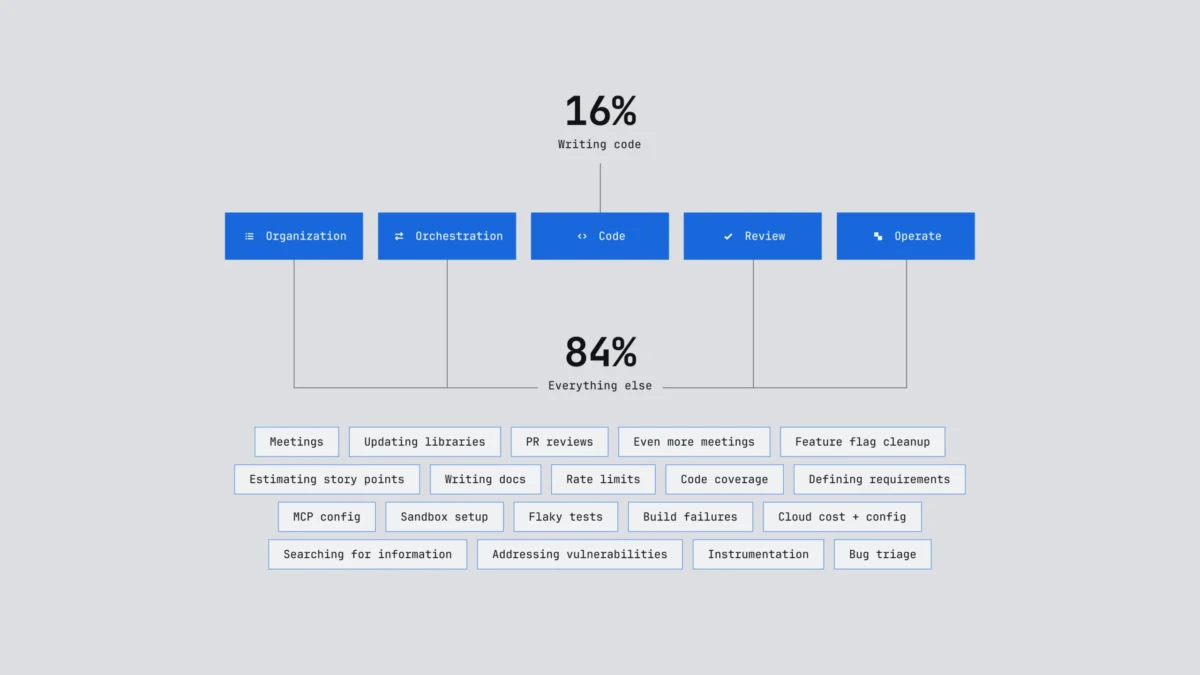
The current discourse surrounding artificial intelligence in software development has predominantly focused on the enhancement of individual engineer productivity. However, longitudinal data and internal findings from Atlassian, involving a workforce of 6,000 engineers and over 1 million agent sessions, indicate that accelerating individual coding tasks represents only a minor fraction of the potential organizational impact. The true challenge lies in transforming the entire software delivery lifecycle, from the initial conceptualization of an idea to its final deployment in production.
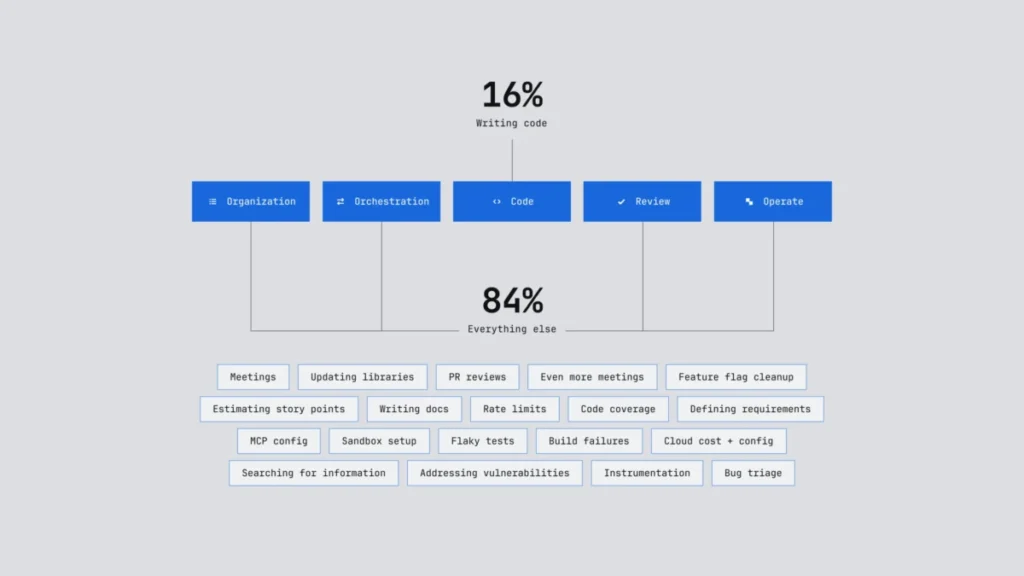
Research conducted by DX provides a critical perspective on this gap, showing that team throughput improvements tend to plateau at approximately 10%, even as the adoption of AI-assisted pull requests approaches 100%. This discrepancy is rooted in how developers actually allocate their time. According to Atlassian’s Developer Experience Report, engineers spend only about 16% of their workday writing code. The remaining 84% is consumed by planning, coordination, context gathering, code reviews, operational tasks, and the critical decision-making processes that link the various stages of delivery. While coding agents have successfully compressed the execution phase, the activities occurring to the "left" and "right" of the coding process have largely failed to keep pace.

Atlassian has utilized its own organization as a proving ground for AI-native delivery to understand the systemic shifts required when moving from accelerating individual steps to redesigning the entire workflow. The company’s findings across more than 20 products reveal that AI adoption often outpaces organizational change. When engineers are given the freedom to use specialized agents and Integrated Development Environments (IDEs) of their choice, the surrounding workflows frequently remain static, creating bottlenecks that limit the benefits of faster code generation.
One of the primary lessons learned is that in a high-speed execution environment, intent becomes the most critical factor. In traditional organizations, the planning phase remains heavily manual. Specifications are written in documents, broken down into tickets by different individuals, and triaged by others. By the time an AI agent or a human engineer receives a work request, much of the original context has been lost. Atlassian addresses this by focusing on the "left of code" through tools like Jira Planner and the Teamwork Graph.
Jira Planner was developed to transform fragmented planning into collaborative implementation plans. By drawing on the Teamwork Graph—which integrates data from code repositories, team history, prior Jira items, and shared knowledge—the tool allows product managers, designers, and engineers to contribute their perspectives simultaneously. This process ensures that requirements are aligned and tasks are broken down into executable units. Furthermore, Jira Planner uses task context to recommend whether specific work items should be handled by human teammates or AI agents, though the final decision remains with the team. This approach shifts the focus from simply planning faster to creating work that is better prepared for execution.

The importance of capturing the "conversation behind the request" was also highlighted through the use of Jira Cloud for Slack and Microsoft Teams. Many development tasks originate in informal discussions where bugs are identified or product decisions are settled. By allowing users to describe tasks in natural language within these communication platforms, Jira can capture the rationale, scope, and potential edge cases of a request. This ensures that when a person or agent begins work, they are starting from a foundation of comprehensive context rather than an isolated ticket.
Further refinement of the "left of code" involves the Triage Agent. Even after a request enters the system, teams often spend significant time on administrative tasks such as checking for duplicates, setting priorities, and assigning ownership. The Triage Agent automates the initial pass of these activities by evaluating the issue against its surrounding context and recommending updates to issue types, labels, or owners. The lesson for engineering leaders is that improving the planning phase is not about inserting an agent into every task, but about enhancing the quality and structure of the work entering the system.
In terms of orchestration, Atlassian found that at scale, the focus must shift from simply choosing an agent to connecting the right work with the right agent and delegating based on the workflow. Within the Atlassian ecosystem, engineers can utilize various tools such as Cursor or Claude. Regardless of the tool used, Jira serves as the system of record, ensuring the agent receives the necessary context, specifications, and repository access. Once a task is completed, the agent returns a draft pull request and summary to the work item for human review.

This orchestration is particularly effective for high-volume, repetitive tasks like vulnerability remediation. Rather than waiting for a human engineer to address each issue manually, a coding agent can proactively generate validated pull requests for review. Atlassian also utilizes Jira Automation to create event-driven loops. For instance, a specific label can trigger an agent to clean up stale feature flag logic. While lower-risk changes may be handled directly by agents, higher-impact work is summarized and routed to human developers, maintaining a balance between speed and oversight.
The "right of code"—the phase involving implementation confirmation, risk identification, and operational feedback—is equally critical. Generating a code change is only one component of delivery; teams must still ensure that the implementation meets the original requirements and adheres to organizational standards. Atlassian has moved away from burying standards in static documentation. Instead, these standards are embedded directly into the workflow. An AI Reviewer checks code changes against defined practices for logging, security, and frameworks, as well as against the original Jira requirements. This allows human reviewers to focus their time on high-level judgment and routine condition checks, while remaining accountable for the final decision.
Central to all these advancements is the concept of "connected context." Atlassian’s data indicates that the most advanced AI models are only as effective as the organizational understanding they are provided. Without access to engineering standards, architectural decisions, and clear ownership data, agents are prone to missing the intent of a request, leading to unnecessary rework. The Teamwork Graph serves as the backbone for this context, aggregating relationships across Jira, Confluence, Bitbucket, Slack, Figma, and GitHub.

By grounding AI in this connected context, Atlassian observed a 44% improvement in answer quality and a 48% reduction in token consumption. This context is also made available to external agents and developers through the Model Context Protocol (MCP) and Command Line Interface (CLI), allowing the organizational knowledge base to evolve through the execution of work. Every decision, incident, and outcome adds to the collective knowledge, which in turn improves future actions.
Governance and measurement also require a redesign for an agentic workforce. Governance is no longer about blanket approvals but about defining the boundaries of agent autonomy and ensuring activity is visible. Jira work items now include agent sessions and activity feeds, allowing teams to trace changes and review outcomes. Measurement of performance is conducted within the same system that holds the work and the context. By integrating a system of record with a context engine and embedded agents, organizations can gain a comprehensive view of the software development lifecycle.
The overarching takeaway from Atlassian’s internal transformation is that the greatest opportunity for AI in software development lies in redesigning the system of delivery rather than just the act of coding. This involves ensuring that intent is clear and work is prepared for execution, grounding every action in a connected graph of organizational context, and utilizing a system of record to orchestrate work across both humans and agents. While the model is still evolving, its application at scale demonstrates that the path to true organizational velocity requires a holistic rethink of how work moves from an idea to a finished product.