 11
11
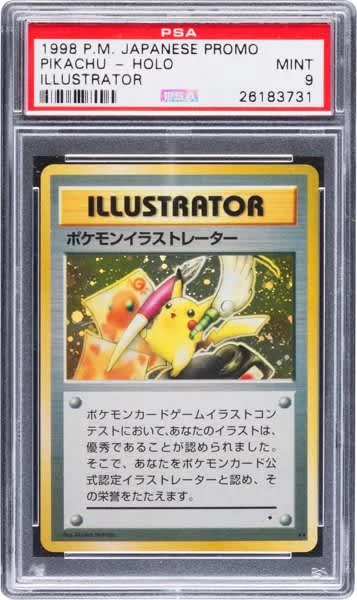
Social media influencer and wrestler Logan Paul has shattered the world record for an auctioned trading card, selling a rare "Pikachu Illustrator" Trainer Promo Hologram card for a staggering $16.5 million. The buyer, AJ Scaramucci, son of investor and former White House communications director Anthony Scaramucci, views the acquisition not merely as a collectible, but as a significant investment.
The "Pikachu Illustrator" card, a coveted item from 1998, is one of an estimated few dozen in existence. For AJ Scaramucci, the founder and Managing Partner of Solari Capital, this purchase marks a pivotal moment in his relatively short collecting journey, which began during the COVID-19 pandemic. He sees the Pokémon card’s cultural significance as surpassing even that of renowned art. "I mean, Picassos are great," Scaramucci stated in an interview, "But Pokémon means way more than just a Picasso painting to people."
Following his successful bid, Scaramucci announced his intention to embark on a "planetary treasure hunt" with his younger brother. This ambitious endeavor aims to acquire a diverse portfolio of scarce, real-world assets across various categories.
The trading card market has experienced an unprecedented surge in recent years. Data from Card Ladder, an analytics firm specializing in trading card prices and sales, indicates that the monthly sales volume in the secondary trading market has nearly doubled over the past two years. This trend is further underscored by eBay CEO Jamie Iannone, who highlighted collectibles, particularly trading cards, as the primary driver of gross merchandise volume growth in the company’s fourth-quarter earnings call.
Logan Paul’s own investment in the "Pikachu Illustrator" card is a testament to its escalating value. He acquired the card in 2021 for nearly $5.3 million, realizing a profit of over 200% on his sale. To contextualize this remarkable return, Card Ladder’s "Pokémon index" has appreciated by 145% in the past year, significantly outperforming traditional market benchmarks such as the S&P 500, which saw a 15.2% increase, and even Alphabet (Google’s parent company), a component of the "Magnificent Seven," which grew by 73.4% over the same period.
Ken Goldin, founder and CEO of Goldin Auctions (owned by eBay), which facilitated the record-breaking auction, observed the astronomical growth in the market, particularly in 2025. He attributes this surge to a growing segment of buyers who are either passionate collectors or firmly believe that trading cards and collectibles represent a legitimate alternative asset class.
Scaramucci embodies this dual motivation, purchasing Pokémon cards for both personal enjoyment and their investment potential. He asserts that the compounded annual growth rate of these cards is "out of control" and that they should be recognized and treated as investments due to their inherent value. Furthermore, Scaramucci views these collectibles as a strategic play in the "debasement trade," a strategy employed by investors concerned about currency devaluation who seek to preserve wealth in hard assets.
The concept of treating collectibles as alternative assets is not novel, although it remains unconventional. Assets like fine wine and art have historically been utilized for portfolio diversification. Paul Karger, co-founder and managing partner at wealth advisory firm TwinFocus, acknowledges that his firm advises clients who collect art, wine, watches, and even guitars. However, he emphasizes a cautious approach, advising clients to prioritize passion over pure investment when engaging with such assets. "Think of it as a passion first, and kind of an investment second," Karger advised. "You hope they go up over time, but they’re absolutely not a replacement to financial assets, it’s just maybe a complement at the margin."
Karger also highlighted the inherent risks associated with collectibles, including their illiquid nature and their valuation dependence on market sentiment and auction outcomes. Kaycee LeCong, managing director of the family office at Brighton Jones Wealth Management, added another significant risk: capital gains taxes on collectibles are taxed at 28%, a rate considerably higher than the approximately 15% to 20% capital gains tax on stocks.
Despite these risks, Goldin anticipates that an increasing number of individuals will perceive collectibles, particularly trading cards, as viable alternative assets. He believes that prominent sales, such as Logan Paul’s record-breaking transaction, coupled with the increasing availability of data, will foster greater price discovery and attract more participants to the market.
Scaramucci’s "treasure hunt" will be spearheaded by a new company, Treasure Trove, which will receive funding from Solari Capital. While specific operational details of Treasure Trove remain undisclosed, Scaramucci has not yet revealed whether he intends to sell the "Pikachu Illustrator" card or any other collectibles in his growing portfolio should their value continue to appreciate.
In a lighthearted moment following his win, Scaramucci expressed a desire to acquire the Declaration of Independence as part of his treasure hunt, though he acknowledged the immense effort required to achieve such a goal. For now, Scaramucci’s current strategy remains intentionally opaque. "For now, if you think I’m just a crazy person buying up real-world, scarce assets," he concluded, "that’s all you need to know."