 11
11
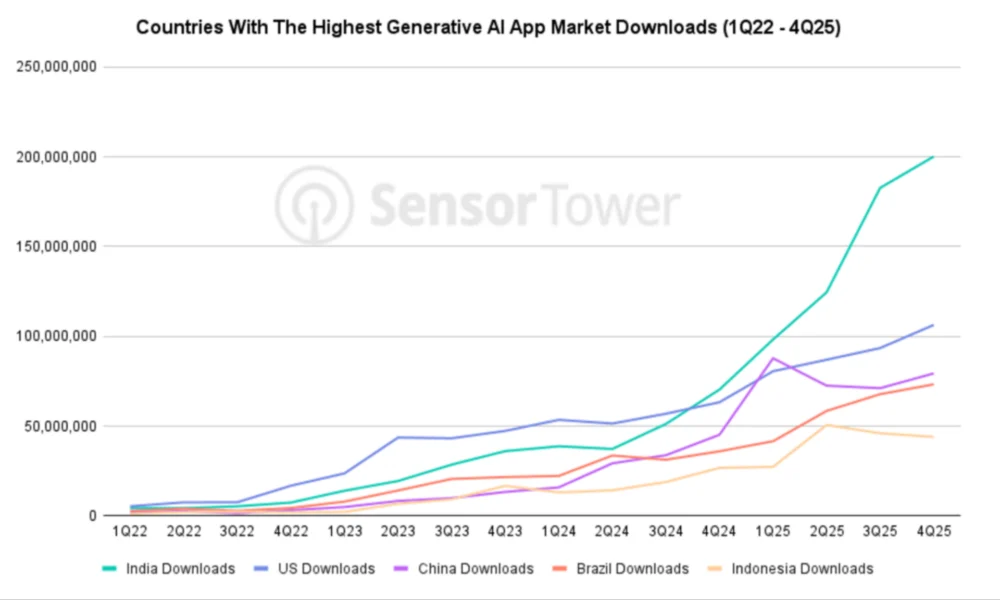
Tech giants’ aggressive push for artificial intelligence adoption in India is reaching a pivotal moment as companies begin to phase out free promotional offers, signaling a strategic shift towards converting the world’s fourth-largest economy into a significant source of paid subscribers. This move comes after India emerged as the largest global market for generative AI app downloads, presenting both immense opportunity and substantial monetization challenges for leading AI firms. The transition marks a crucial turning point, testing the long-term viability of business models reliant on converting a massive, but historically price-sensitive, user base into a paying customer segment.
India solidified its position as the world’s largest market for generative AI application downloads in 2025, according to comprehensive data from market intelligence firm Sensor Tower. The nation significantly widened its lead over the United States, experiencing an astounding 207% year-over-year increase in installations. This unprecedented surge underscores India’s burgeoning digital landscape and its rapid embrace of cutting-edge artificial intelligence technologies. The growth was particularly pronounced in the latter half of 2025, with downloads peaking in September and October, registering impressive year-over-year growth rates of approximately 320% and 260% respectively. This made India a crucial battleground for global AI players seeking to expand their user base and establish early dominance in a rapidly evolving technological frontier.
In a concerted effort to accelerate user growth within India’s highly price-sensitive market, major AI developers such as OpenAI, Google, and Perplexity rolled out extensive free premium offers throughout 2025. These initiatives were strategically designed to lower the barrier to entry for millions of potential users, fostering widespread adoption and familiarity with generative AI capabilities without immediate financial commitment. OpenAI, a leader in the generative AI space and creator of ChatGPT, introduced "ChatGPT Go," offering free access for one year to users across India. This move aimed to rapidly onboard a massive number of users onto its flagship chatbot platform, familiarizing them with its advanced conversational AI features.
Google, leveraging its deep ties within the Indian market, forged a significant partnership with Reliance Industries, one of India’s largest conglomerates. Through this collaboration, Google offered free access to its AI Pro services to millions of Jio users, tapping into the extensive subscriber base of Reliance Jio, a dominant telecom provider in the country. This strategic alliance allowed Google to penetrate deeply into the market, reaching a broad spectrum of internet users. Perplexity, an AI-powered search engine, also engaged in similar promotional activities, including a bundled Pro offer with Indian telecom giant Airtel. The strategy across these companies was clear: establish a strong foothold, cultivate a loyal user base, and drive engagement through initial free access, with the long-term vision of converting these highly engaged users into paying subscribers once the promotional periods concluded.
Beyond user acquisition strategies, leading AI firms have actively supported India’s ambition to transform into a global artificial intelligence hub. This commitment was prominently displayed at a major AI summit held in New Delhi just last week, an event that underscored the nation’s rising stature in the global AI race. The high-profile gathering drew an impressive roster of global AI luminaries, including OpenAI’s CEO Sam Altman, Anthropic’s co-founder and CEO Dario Amodei, and Alphabet CEO Sundar Pichai. Their attendance at the summit served as a powerful testament to India’s increasing influence and strategic importance in the rapidly evolving global AI landscape. The Indian government’s proactive push for AI development, coupled with the keen interest from global tech leaders, signals a strong intent to position India at the forefront of AI innovation, research, and application.
However, the era of widespread free access appears to be drawing to a close, marking a critical inflection point for the Indian AI market. Several of these initial promotional pushes are now winding down, setting the stage for a genuine test of market viability and consumer willingness to pay. Perplexity, for instance, concluded its bundled Pro offer with Airtel in January, requiring users to either subscribe or revert to a basic free tier. Similarly, OpenAI’s free ChatGPT Go access in India is no longer available, prompting users to consider paid subscriptions for continued premium features. These developments are poised to provide AI companies with a clearer, more direct assessment of how many of their newly acquired users, accustomed to free services, will transition into paying subscribers. The shift from a growth-at-all-costs strategy to a monetization-focused approach will reveal the true commercial potential and elasticity of demand within India’s massive user base.
Despite the phenomenal download growth, India currently generates a disproportionately small share of global AI app revenue. Sensor Tower data shared with TechCrunch reveals a stark contrast: India accounts for roughly 20% of global generative AI app downloads but contributes only about 1% of in-app purchases. This significant disparity highlights the formidable monetization challenge facing AI developers in one of the industry’s fastest-growing markets. The initial surge in usage, driven by aggressive promotions and a strong cultural affinity for free digital services, did not consistently translate into immediate revenue gains. In November and December 2025, for example, AI app in-app purchase revenue in India experienced sequential declines of 22% and 18% month-over-month, respectively.

ChatGPT, a dominant player in the Indian AI market, witnessed an even sharper drop in revenue, falling 33% and 32% over the same two-month period. This decline directly followed the November launch of its free sub-$5 ChatGPT Go access, clearly illustrating the immediate, albeit temporary, impact of aggressive promotional strategies on revenue streams. With ChatGPT commanding over 60% of generative AI in-app revenue in India, any alterations to its pricing strategy carry substantial implications for the overall market performance and revenue generation across the sector. The challenge now for AI companies is to convert a user base largely accustomed to free or heavily subsidized services into a sustainable revenue source without alienating them.
Sensor Tower attributes the accelerated adoption of generative AI apps in India throughout 2025 to a confluence of factors. These include a wave of new product launches, such as the debut of innovative platforms like DeepSeek, Grok, and Meta AI, which introduced fresh functionalities and competition to the market. Concurrently, significant upgrades to established chatbots like ChatGPT, Google Gemini, Claude, and Perplexity further enhanced their capabilities and appeal, drawing in more users through improved performance and feature sets. Beyond technological advancements and competitive product offerings, viral interest in AI-generated content also played a crucial role in fueling adoption. Content creation and editing tools leveraging generative AI proved particularly popular, accounting for seven of the top 20 most downloaded generative AI applications in India in 2025. This indicates a strong and practical demand for AI applications that empower users to create, modify, and enhance digital content, from images and videos to text and audio.
The user surge in India has been equally pronounced, underscoring the sheer scale of the market. In 2025, India accounted for approximately 19% of the global user base of leading AI assistant apps, surpassing the United States, which stood at 10%. This highlights India’s critical role in driving global user numbers for AI services. ChatGPT continues to maintain a dominant position in the Indian market in terms of monthly active users (MAU). However, rivals like Google’s Gemini and Perplexity have also experienced rapid growth, particularly following their respective promotional offers and strategic partnerships. Sensor Tower data from earlier in the year confirmed ChatGPT as the most downloaded generative AI app not only in India but globally in 2025. More recently, OpenAI CEO Sam Altman announced that the chatbot now boasts more than 100 million weekly active users in India, a testament to its widespread penetration and daily utility for a vast segment of the population.
Despite the impressive user numbers and rapid adoption, engagement metrics in India still lag behind more mature markets. In 2025, users of leading AI chatbot apps in the United States spent approximately 21% more time per week on the applications compared to their Indian counterparts. Additionally, U.S. users logged an average of 17% more sessions. This suggests that while India has enthusiastically embraced AI apps in terms of downloads and sheer user volume, the depth of engagement and seamless integration into daily routines is still evolving. This gap presents both a challenge and an opportunity for AI developers to deepen user engagement and cultivate habits that support long-term retention.
The enduring appeal of India as a critical market for AI services stems from its colossal digital base. With over a billion internet users and approximately 700 million smartphone owners, India represents one of the largest potential markets for digital services globally. This massive addressable audience, coupled with a rapidly digitizing economy and a young, tech-savvy population, makes it an indispensable battleground for AI firms vying for user growth and future market share. The country’s robust digital public infrastructure, including platforms like UPI for payments, also creates a fertile ground for digital service adoption.
Sneha Pandey, an insights analyst at Sensor Tower, emphasized that the promotional push in India reflects a broader strategy by AI firms to mitigate pricing friction in a highly value-conscious market. The underlying bet is that early user adoption and deep engagement will ultimately translate into stronger long-term retention once free access periods expire. Pandey predicts that "AI in-app revenues will likely see meaningful but gradual improvement as users become more deeply integrated into these platforms, making sustained engagement paramount." She further highlighted that pricing pressure in India is expected to remain elevated, primarily due to the country’s young and value-conscious user base, which has a lower average purchasing power compared to developed nations. This necessitates a strategic focus on lower-cost tiers, attractive telecom bundles, and micro-transaction models to ensure long-term retention and sustainable monetization in a market where even small subscription fees can be a barrier.
Entering 2026, ChatGPT maintained its clear market leadership in India, reporting 180 million monthly active users in January, according to Sensor Tower. Google’s Gemini followed with a significant 118 million MAU, while Perplexity recorded 19 million, and Meta AI stood at 12 million. These figures underscore both the immense scale of India’s AI opportunity and the persistent challenge for companies to effectively convert rapid user adoption into consistent and substantial revenue streams.
The current transition period in India’s generative AI market will serve as a crucial test for the industry’s monetization strategies. As free trials conclude and companies pivot towards paid subscriptions, the ability to demonstrate clear value, offer flexible and affordable pricing models, and maintain high user engagement will be paramount for securing long-term success in this dynamic and vital global market. The coming months will provide critical insights into whether India’s vast user base is ready to pay for AI services, transforming its download dominance into revenue leadership. Google, OpenAI, and Perplexity did not respond to requests for comments regarding these strategic shifts and their future pricing models in India.