 11
11
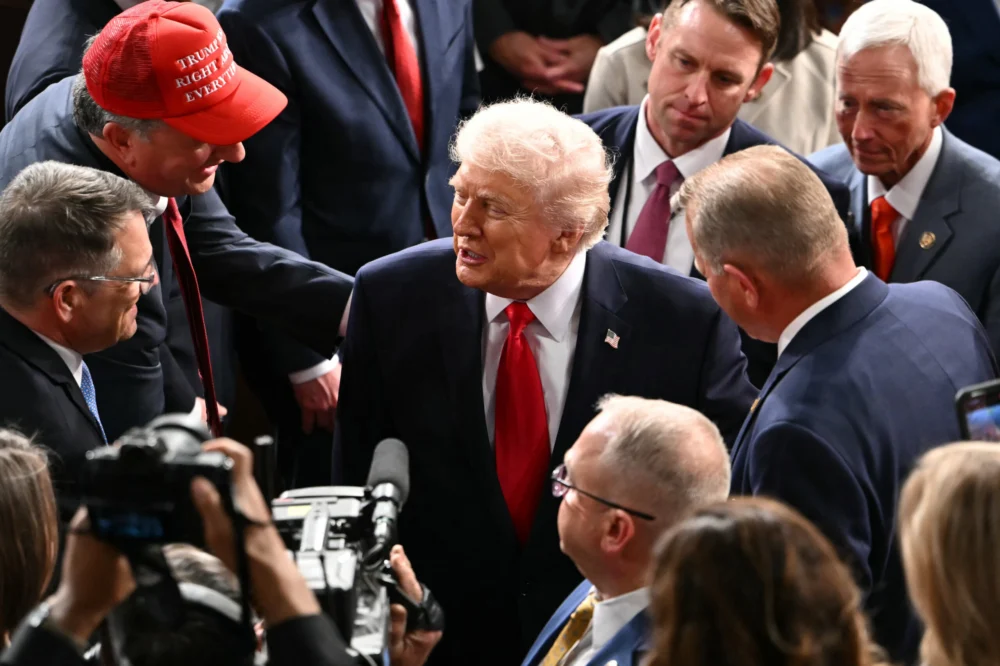
U.S. President Donald Trump delivered his State of the Union address on February 24, 2026, a speech notable for its conspicuous absence of direct mentions of China, despite his upcoming diplomatic trip to Beijing scheduled from March 31 to April 2. This calculated omission, occurring just weeks before a high-stakes visit that marks the first by a U.S. president since 2017, has sparked analysis regarding the strategic underpinnings of the Trump administration’s approach to its complex relationship with the world’s second-largest economy.
The address, which was the longest State of the Union speech delivered by any U.S. president, traversed a broad spectrum of domestic and international issues, including economic performance, inflation, and trade tariffs. While President Trump referenced "Russian and Chinese military technology" in the context of the capture of Venezuelan President Nicolas Maduro, China itself was not directly named in relation to trade, competition, or other key bilateral concerns. This stands in stark contrast to his first term, from 2017 to 2021, where his State of the Union addresses consistently featured direct references to China, often highlighting perceived threats emanating from Beijing to the United States.
Analysts suggest this shift in rhetoric is a deliberate political maneuver. Gabriel Wildau, managing director at Teneo, posited that Trump’s reticence is aimed at avoiding confrontation with China during an election year, particularly with the U.S. midterm elections looming in November. "Stability in U.S.-China relations is a priority for the president at least this year and potentially for the rest of his term," Wildau commented, indicating a desire to de-escalate tensions as a strategic imperative.

However, the confirmation of the exact dates for President Trump’s Beijing visit remains pending from China’s foreign ministry, a detail that has not gone unnoticed. George Chen, a partner at The Asia Group, observed that this lack of definitive scheduling "makes Trump look more desperate to visit China more than how much [Chinese president Xi Jinping] wants to host him." Chen further interpreted the muted mention of China in the speech as "another example to show how Trump stays cautious now about U.S.-China relations."
The economic backdrop to this diplomatic engagement is significant. In the spring of the previous year, the U.S. and China engaged in a tariff escalation, with rates on each other’s goods exceeding 100%. A trade truce was eventually reached in October, temporarily reducing tariffs to below 50% for the subsequent year. Concurrently, Beijing implemented tighter restrictions on rare earth exports, a sector where China holds a dominant position in the global supply chain, supplying critical minerals essential for numerous technologies.
Wildau suggested that President Trump’s focus in the State of the Union on what he perceives as "glorifying U.S. military triumphs over weak states like Venezuela makes better election year politics than fighting with China over rare earths." This implies a prioritization of domestically resonant narratives over potentially divisive international trade disputes.
Further complicating the tariff landscape, the U.S. Supreme Court recently invalidated tariffs imposed by the Trump administration on a range of countries, prompting the president to quickly signal an intention to establish alternative justifications for raising global tariff rates.

Within China, state media outlets on Weibo acknowledged opposition to Trump’s speech within Congress, but broader public attention to the address was reportedly muted. Yue Su, principal economist at the Economist Intelligence Unit (EIU), highlighted that President Trump’s limited engagement with China in his speech also reflects the inherent unpredictability of his policy towards Beijing. She contrasted this with the approach of his predecessor, Joe Biden, who "consistently referred to China in his speeches, which underscored a degree of continuity and predictability in his China policy." The Democratic Party’s rebuttal to Trump’s address, delivered by Virginia Governor Abigail Spanberger, directly addressed Beijing, criticizing the president for ceding economic power and technological strength to Russia and China, and for making "plans for war with Iran."
The upcoming Beijing trip holds considerable potential for significant diplomatic and economic developments. For a president who has previously singled out President Xi Jinping by name in public forums, the deliberate absence of China from his State of the Union address signals a strategic calculation. Su of the EIU suggested that if President Trump secures a favorable deal during his visit, "he could easily frame it as a major achievement for his base." Conversely, should negotiations falter, a more hardline stance could also be presented domestically in a positive light.
Steven Okun, founder and CEO of Singapore-based APAC Advisors, concurred that the speech’s focus was understandably geared towards issues impacting the midterm elections, which do not typically include China as a central theme. However, he pointed out that addressing U.S. consumer affordability would be more directly and quickly impacted by lowering tariffs on Chinese goods. "So, we may see a deal on tariffs with China end of March or early April," Okun stated on CNBC’s "Access Middle East."
The presidential delegation accompanying Trump to China is expected to include numerous U.S. company executives, signaling opportunities for forging deals, including potential Chinese purchases of U.S. agricultural products. Marko Papic, chief strategist at global investment research firm BCA Research, offered a concise yet potent observation regarding the limited discussion of China in the State of the Union: "A big deal is coming!" This sentiment underscores the anticipation surrounding the forthcoming diplomatic engagement and its potential ramifications for the bilateral relationship and global markets.