 11
11 1
1 2
2 3
3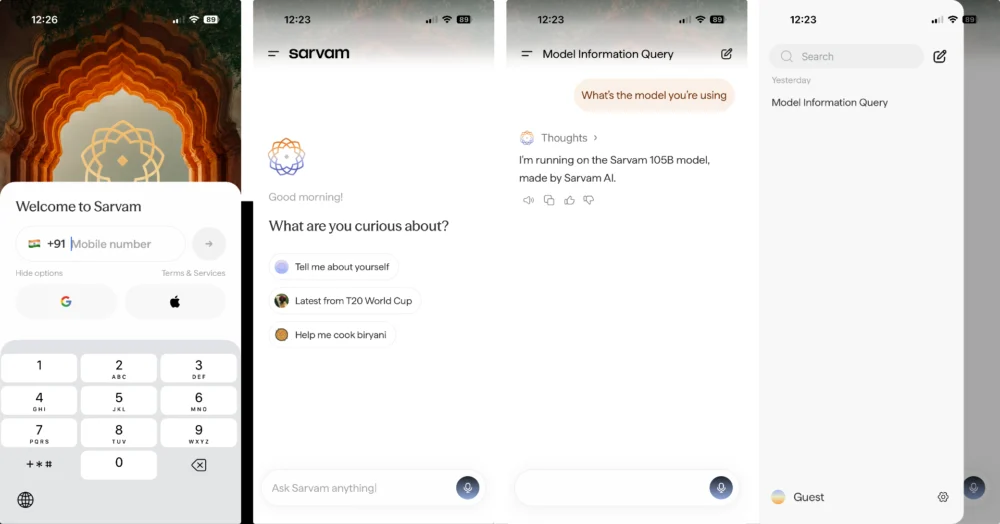
Sarvam, a pioneering Indian artificial intelligence startup with a dedicated focus on developing robust AI models specifically tailored for local languages and users, officially launched its Indus chat application on Friday. Available across web and mobile platforms, this strategic move marks Sarvam’s direct entry into India’s rapidly expanding generative AI market, a landscape currently dominated by established global titans such as OpenAI, Anthropic, and Google.
The timing of this launch is particularly significant, coinciding with India’s emergence as a crucial global battleground for generative AI adoption and innovation. Recent data underscores the immense potential and existing user base within the country. OpenAI CEO Sam Altman recently revealed that ChatGPT boasts over 100 million weekly active users in India, highlighting a massive appetite for AI-powered conversational tools. Similarly, Anthropic reported that India accounts for a substantial 5.8% of its total Claude usage, positioning it as the second-largest market globally for the advanced AI assistant, trailing only the United States. This concentrated user engagement signals a vibrant, digitally-savvy population eager to embrace new AI technologies, making India an irresistible frontier for both domestic and international AI firms.
At the core of the Indus chat app is Sarvam’s newly unveiled Sarvam 105B model, an ambitious 105-billion-parameter large language model. This sophisticated model represents a significant leap in indigenous AI development, designed to understand the nuances of India’s diverse linguistic landscape and cultural context. The app’s release follows closely on the heels of a major announcement two days prior, where Bengaluru-based Sarvam introduced both its 105B and a more compact 30B model at the prestigious India AI Impact Summit in New Delhi. This high-profile event, a nexus for AI policy, innovation, and industry collaboration, served as a platform for Sarvam to not only showcase its foundational models but also to outline an expansive vision encompassing enterprise initiatives and strategic hardware plans. During the summit, Sarvam announced pivotal partnerships, notably with HMD to integrate AI capabilities into Nokia feature phones, a move poised to democratize AI access across India’s vast and varied user base, and with Bosch for cutting-edge AI-enabled automotive applications, signaling a foray into industrial and smart mobility sectors.
Currently in its beta phase, the Indus app is accessible to users on Apple’s iOS ecosystem, Google’s Android platform, and via a dedicated web interface. The application offers a user-friendly experience, allowing individuals to engage with the AI through both typed and spoken queries, receiving responses in corresponding text and audio formats. This multimodal interaction is particularly vital in India, where varying levels of digital literacy and linguistic preferences necessitate flexible input and output options. For ease of access, users can sign in using their phone numbers, Google or Microsoft accounts, or Apple IDs, streamlining the onboarding process. At present, the service is geographically limited to India, ensuring a focused rollout and optimization for its target demographic.
Despite its promising debut, the Indus app, as with many nascent technological offerings, currently operates with certain limitations. Users do not have the immediate option to selectively delete their chat history without resorting to a full account deletion, which could raise concerns regarding data privacy and user control. Furthermore, the app’s ‘reasoning feature,’ a core component of its intelligence, cannot be deactivated, potentially leading to slower response times in certain scenarios as the model processes complex queries. Sarvam has proactively communicated these initial constraints, including a cautionary note regarding potential access restrictions as it progressively scales up its underlying compute capacity.

Pratyush Kumar, co-founder of Sarvam, addressed these early-stage realities, stating on X, "We’re gradually rolling out Indus on a limited compute capacity, so you may hit a waitlist at first. We will expand access over time." He also emphasized the company’s commitment to iterative improvement, actively seeking and valuing user feedback to refine the app’s performance and features. This transparent approach underscores a common strategy in the fast-evolving AI landscape, where rapid deployment is often followed by continuous refinement based on real-world usage.
Founded in 2023, Sarvam has swiftly garnered significant financial backing, raising an impressive $41 million to date. This substantial investment comes from a consortium of prominent venture capital firms, including Lightspeed Venture Partners, Peak XV Partners, and Khosla Ventures. The confidence demonstrated by these high-profile investors highlights a strong belief in Sarvam’s vision and its strategic imperative to build large language models specifically ‘tailored for India,’ a crucial differentiator in a market historically served by global, generalized models.
Sarvam’s emergence is emblematic of a broader, strategic trend unfolding within India: the rise of a small but increasingly influential group of domestic startups committed to developing indigenous alternatives to global artificial intelligence platforms. This movement is driven by India’s overarching national objective to achieve greater control and sovereignty over its critical AI infrastructure. By fostering local innovation, India aims to ensure that its AI development aligns with its unique cultural contexts, linguistic diversity, and national priorities, thereby reducing reliance on foreign technologies and securing its digital future. This push for self-reliance in AI is not merely economic but also strategic, encompassing data security, ethical AI governance, and the cultivation of a robust, home-grown technological ecosystem.
This comprehensive reporting on Sarvam’s launch and its broader implications for India’s AI landscape is part of TechCrunch’s ongoing coverage of significant technological advancements. TechCrunch, as a leading voice in the tech industry, also hosts events such as the upcoming TechCrunch event in Boston, MA, scheduled for June 9, 2026, which continues to bring together innovators and industry leaders.
Jagmeet Singh, the author of this report, diligently covers startups, tech policy-related updates, and all other major tech-centric developments originating from India for TechCrunch. Prior to his tenure at TechCrunch, Jagmeet served as a principal correspondent at NDTV, further solidifying his expertise in the Indian technology sector. For direct communication or to verify outreach, Jagmeet can be reached via email at [email protected].