 11
11
BEIJING – S&P Global Ratings has significantly lowered its forecast for China’s property sales in 2026, citing an entrenched downturn that has led to a persistent oversupply of housing. Barely two months into the year, the firm now predicts that primary real estate sales will likely drop by 10% to 14% in 2026, a stark revision from the 5% to 8% decline anticipated in October of the previous year.
Analysts at S&P Global Ratings described the current market situation as a "downturn so entrenched that only the government has capacity to absorb the excess inventory." They suggested that state intervention, such as purchasing unsold properties to create affordable housing, could be a potential solution. However, they noted that such efforts have so far been fragmented and insufficient to address the scale of the problem.
China’s property market, which historically accounted for more than a quarter of the nation’s economy, has experienced a dramatic contraction. In just four years, the annual sales volume has been halved. The initial catalyst for this slump was Beijing’s regulatory crackdown on developers’ heavy reliance on debt financing for growth. This policy, designed to curb financial risks, has significantly curtailed the expansion of real estate companies. Compounding these issues, consumer demand for new homes has yet to show any substantial signs of recovery.

Economists have long voiced concerns about overbuilding within China’s property sector. Despite the persistent sales slump, developers have continued to construct new housing units. This has resulted in a sixth consecutive year of completed, yet unsold, new housing inventory, according to S&P Global Ratings. The agency’s analysts concluded that this "glut of primary housing is keeping a property market recovery out of reach." The oversupply is exerting downward pressure on prices, with the agency forecasting a further decline of 2% to 4% this year, mirroring a similar contraction experienced in the preceding year.
The downward spiral in prices is further eroding homebuyers’ confidence, creating what S&P’s report terms a "vicious cycle with no easy escape." A particularly concerning development highlighted by S&P is the acceleration of price declines in China’s largest cities during the fourth quarter of the previous year. These major urban centers were previously considered healthy markets and were anticipated to be the vanguard of any national property market recovery.
Specifically, the cities of Beijing, Guangzhou, and Shenzhen all reported home price declines of at least 3% in 2025. Shanghai stood out as the only major city to record an increase, with home prices rising by 5.7% in 2025 compared to 2024. This divergence suggests a more complex and localized recovery pattern, with key urban markets showing signs of weakening.
The worsening trend in China’s property market was evident throughout 2025. In May, S&P had predicted a 3% decline in new home sales, a figure it subsequently revised to an 8% drop in October. The actual sales figures for 2025 revealed a more severe contraction, with sales falling by 12.6% to 8.4 trillion yuan ($1.21 trillion). This figure is less than half of the 18.2 trillion yuan in annual sales recorded in 2021, underscoring the severity of the market’s decline.

This persistent slump is intensifying pressure on China’s already struggling real estate developers. S&P Global Ratings warned that if sales fall 10 percentage points below their base case scenario for both 2026 and 2027, four of the ten Chinese developers they rate could face downward rating pressure. This analysis does not include China Vanke, a developer that was once among the country’s largest. Late last year, Vanke sought to delay the repayment of some of its debt, signaling financial distress.
Despite the escalating property crisis, Chinese authorities have yet to announce substantial new support measures for the real estate sector. Instead, the government appears to be prioritizing its efforts to develop advanced technologies. Recent analysis from the U.S.-based research firm Rhodium Group suggests that China’s push into high-tech industries is not substantial enough to offset the economic impact of the property slump. This leaves the Chinese economy more reliant on exports for growth and, consequently, more vulnerable to trade tensions.
Top policymakers in China are scheduled to announce the country’s economic goals for the year at a parliamentary meeting next month. The outcome of these discussions will be closely watched for any indications of a shift in policy priorities or potential interventions to address the ongoing property market challenges.
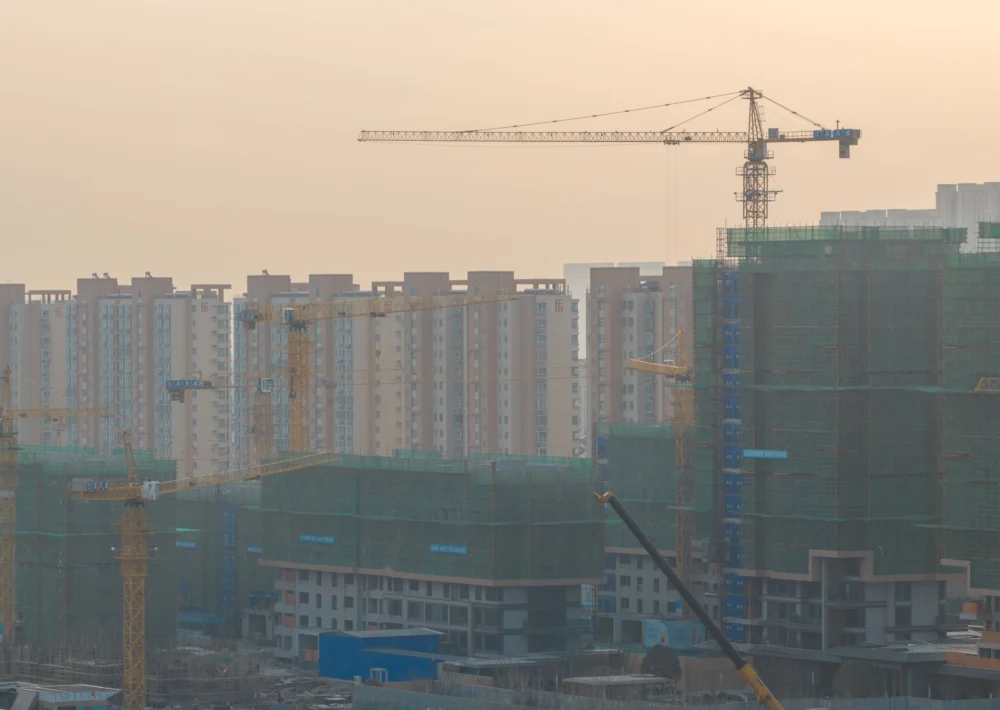
The backdrop to this economic assessment includes ongoing construction projects, such as a real estate development underway along the ancient Huai River in Huai’an City, Jiangsu Province, as captured in an image dated January 29, 2026. This visual serves as a reminder of the ongoing physical development in the sector, even as the market faces significant headwinds.